
Grocery App Open Rates Drop Sharply in August 2026
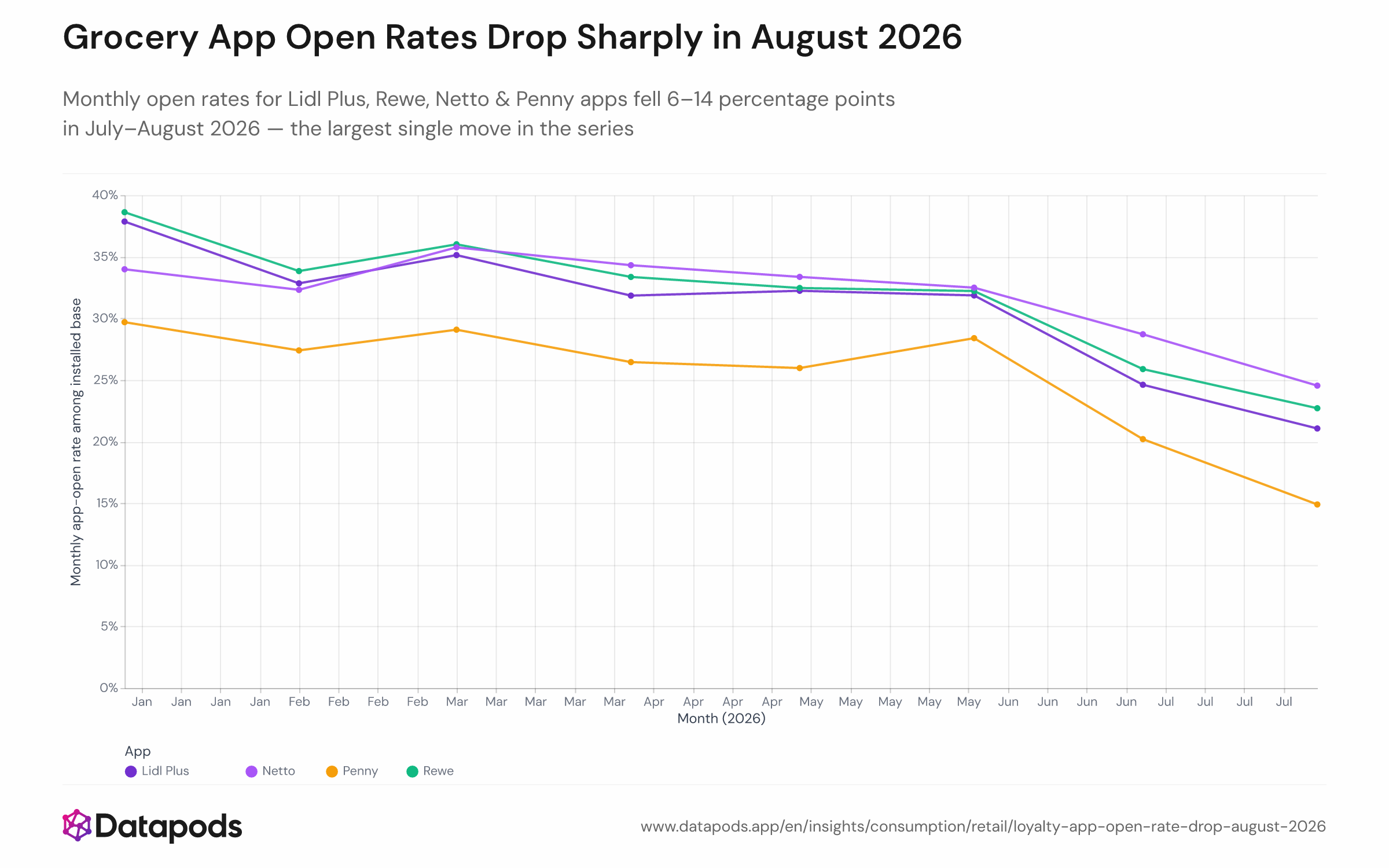
Review Jan–Aug 2026: Monthly open rates for Lidl Plus, Rewe, Netto & Penny apps fell 6–14 percentage points in July–August 2026 — the largest single move in the series
Info
- Sample size
- n = 6,314
- Data date
- Jan–Aug 2026
- Segment
- All segments
- Platform
- Play
- Market
- Germany
Analysis
Among users who already had a grocery loyalty app installed, monthly open rates held flat at 26–39% from January through June 2026, then dropped to 15–25% by August — a 6–14 percentage-point fall that dwarfs any prior month-on-month move. This is the sharpest engagement shift in the eight-month series.
Aldi's campaign or summer holidays — the evidence cuts both ways
Aldi Süd's "Günstig ohne Bonus-App" campaign, which launched on 20 July and ran across eight TV and online spots as well as radio and social media, directly questioned the value of scanning loyalty apps at the checkout. The engagement drop coincides precisely with this campaign window. However, with only around six weeks of post-launch data available, summer-holiday seasonality — when routine shopping trips and habitual phone-scanning behaviour naturally dip — cannot be separated from any campaign effect. The Verbraucherzentrale Bundesverband has separately noted that perceived savings from grocery loyalty apps can be lower than shoppers expect, a narrative Aldi's campaign amplified. Whether engagement recovers in September will be the cleaner test of whether the campaign moved attitudes durably. See how different age groups were affected in Engagement drop by age group.
This analysis is based on public segment data. For deeper cuts, use our Enterprise interface.
Methodology
The metric is the share of users with a given grocery loyalty app installed who opened that app at least once in a calendar month (monthly open rate). Measured on Android devices via app-usage signals, covering Lidl Plus, Rewe, Netto, and Penny apps from January to August 2026. The denominator is restricted each month to users who reported opening at least one app that month, to isolate genuine app-specific behavior from variation in overall telemetry reporting. Results represent a within-cohort share rather than a population-weighted estimate.
These insights are based on the Datapods Panel. Our data comes exclusively from users who are compensated for their anonymity. Become part of the panel & earn from your data