
REWE Churners: Plateau, Not Ramp
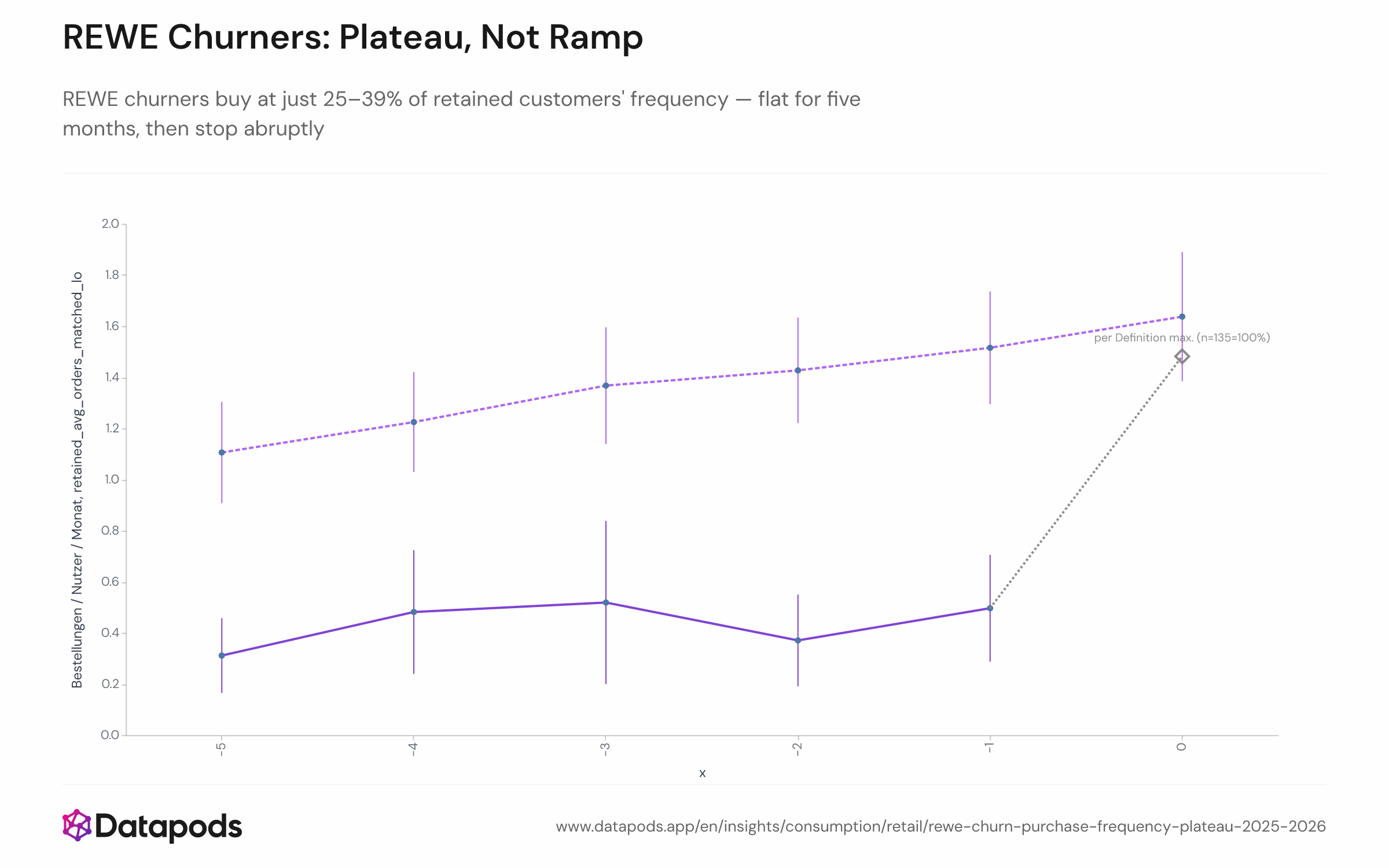
Review Jul 2025 – Jun 2026: REWE churners buy at just 25–39% of retained customers' frequency — flat for five months, then stop abruptly
Info
- Sample size
- n = 331
- Data date
- Jul 2025 – Jun 2026
- Segment
- All segments
- Platform
- Purchases
- Market
- Germany
Analysis
REWE customers who eventually stop shopping don't taper off gradually — they maintain a consistently depressed purchase frequency at 25–39% of retained shoppers for the full five months before their last transaction, then disappear without warning. No downward slope appears in the pre-churn window; the pattern is a flat plateau, not a ramp.
The same signal appears across retail categories
The plateau pattern was first identified at dm-drogerie-markt and was hypothesised to be specific to the episodic, needs-driven rhythm of drugstore shopping. REWE, Germany's second-largest grocery group with over €70 billion in annual revenue, operates at a fundamentally different cadence — weekly grocery runs rather than monthly beauty restocks. Yet the pre-churn behaviour is structurally identical. This suggests the mechanism behind customer marginalization is not category-specific: churners are not gradually withdrawing, but have already mentally exited and simply stop one day. For retention strategy, this means frequency-based early-warning models that look for a declining slope will miss these customers entirely — the signal to act on is the sustained low level itself, not any trend within it. REWE's 2025 launch of its own REWE Bonus loyalty programme — replacing its long-standing Payback partnership — makes understanding this churn structure especially timely, as re-engagement tactics designed for gradual defectors will be misaligned with the actual dynamics at play.
This analysis is based on public segment data. For deeper cuts, use our Enterprise interface.
Methodology
Purchase frequency was tracked for two groups of REWE grocery shoppers over a rolling six-month observation window from mid-2025 to mid-2026. Churned customers are defined as those who made at least one purchase in the first half of the window but none in the second half. Retained customers are a calendar-adjusted control group who remained active across both halves. Frequency is measured month by month for the five months leading up to each churner's last purchase, with the final month excluded as it is definitionally 100% active. The observation covers online grocery purchases attributable to REWE.
These insights are based on the Datapods Panel. Our data comes exclusively from users who are compensated for their anonymity. Become part of the panel & earn from your data