Datapods|Insights
Consumption
Online ShoppingProduct CategoriesRetailSocial Commerce
Digital
Web & BrowsingSearch QueriesApps & MobileAdvertising
Media
Video & StreamingSocial MediaTrends & TopicsUsage Behavior
Resources|For BusinessFor Consumers
Datapods|Insights
ConsumptionOnline ShoppingProduct CategoriesRetailSocial CommerceDigitalWeb & BrowsingSearch QueriesApps & MobileAdvertisingMediaVideo & StreamingSocial MediaTrends & TopicsUsage BehaviorResourcesFor BusinessFor Consumers
InsightsConsumptionRetail
Datapods

Talk to people who actually bought your product.

Use Cases

  • Churn & Win-Back
  • Product & Concept Testing
  • Ad & Creative Testing
  • Customer Journey
  • Competitive Intelligence
  • Audiences & Segmentation
  • Influencers & Creators

Industries

  • Grocery & Drugstore
  • CPG & Brands
  • E-Commerce & Marketplaces
  • Telco & Subscriptions
  • Media & Streaming
  • Apps & Digital

Platform

  • AI Research Agent
  • AI Interviewer
  • Quant Surveys
  • Audience Builder
  • Data API
  • Social Attribution

Company

  • Home
  • About
  • For Consumers
  • The Datapods Panel
  • Insights
  • Contact
  • Resources

Legal

  • Imprint
  • Privacy Policy
  • User Agreement App
  • Privacy Policy App
  • User Agreement Platform
  • Privacy Policy Platform
  • Cookie Policy

©2026 Datapods.app. All rights reserved.

EU Co-financedNRW

Baby Purchases Without Kids: Gift or Own Use?

Results as of 15.07.2026

Review Jan 2025 – Jul 2026: 62% of baby-category purchases by shoppers declaring no children show repeat consumable patterns — consistent with actual childcare, not gifting 37.8% gift-profile
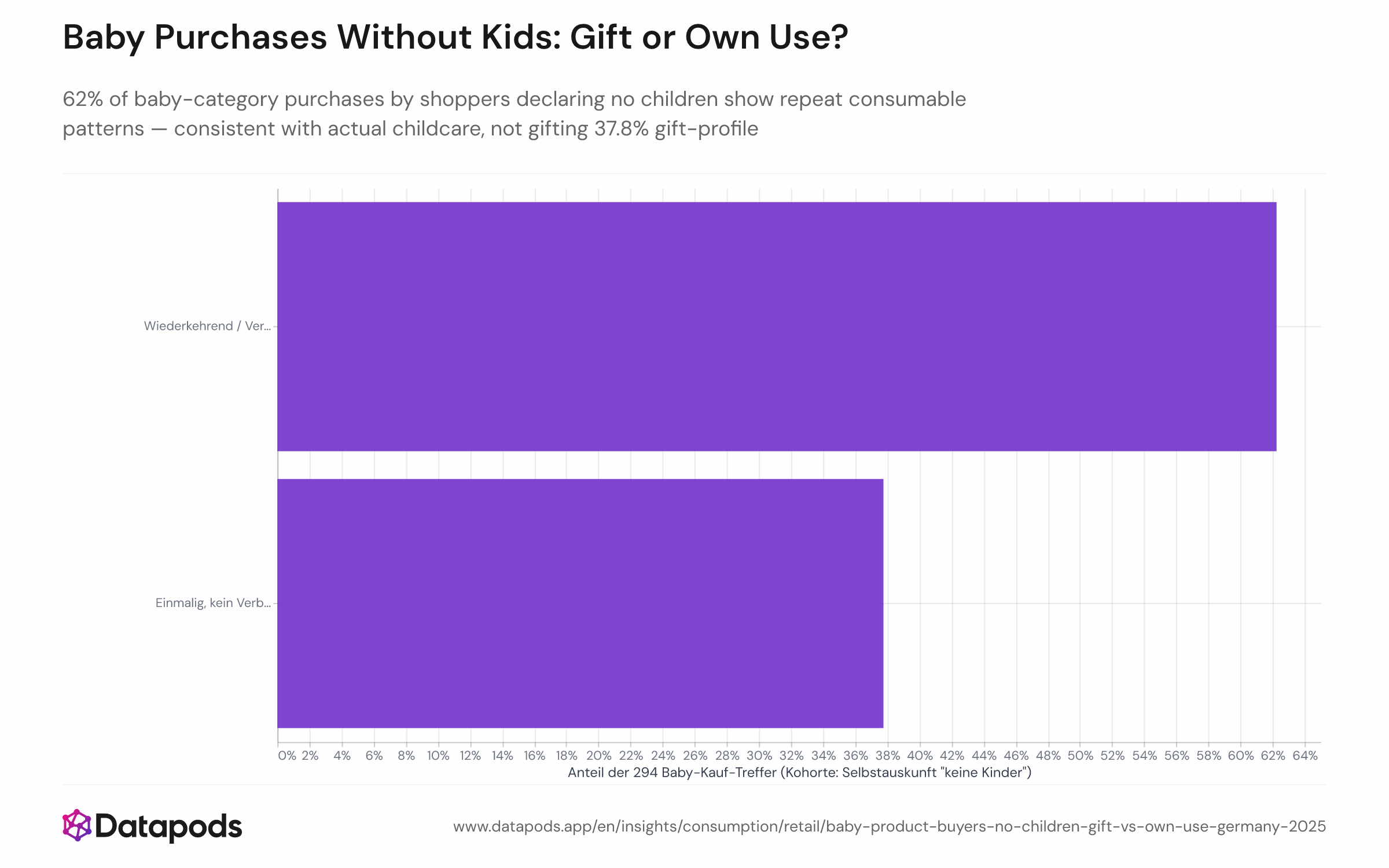
Baby Purchases Without Kids: Gift or Own Use?Donut or bar chart showing the split of 294 baby-category purchases by shoppers declaring no children: 62.2% (183 shoppers) classified as childcare-consistent buying patterns (repeat consumables across multiple months), and 37.8% (111 shoppers) classified as gift-consistent buying patterns (single non-consumable purchase). Observation period: January 2025 to July 2026.Donut or bar chart showing the split of 294 baby-category purchases by shoppers declaring no children: 62.2% (183 shoppers) classified as childcare-consistent buying patterns (repeat consumables across multiple months), and 37.8% (111 shoppers) classified as gift-consistent buying patterns (single non-consumable purchase). Observation period: January 2025 to July 2026.
Donut or bar chart showing the split of 294 baby-category purchases by shoppers declaring no children: 62.2% (183 shoppers) classified as childcare-consistent buying patterns (repeat consumables across multiple months), and 37.8% (111 shoppers) classified as gift-consistent buying patterns (single non-consumable purchase). Observation period: January 2025 to July 2026.
Sample size
n = 294
Data date
Jan 2025 – Jul 2026
Segment
All segments
Platform
Browsing, Email
Market
Germany
Info
Sample size
n = 294
Data date
Jan 2025 – Jul 2026
Segment
All segments
Platform
Browsing, Email
Market
Germany

Analysis

Among 294 baby-category purchases made by online shoppers who declared no children in their profile, 62.2% show a buying pattern consistent with genuine childcare — repeat orders of consumables like diapers, wet wipes, or baby food across multiple months. The remaining 37.8% fit a gift-buying profile: a single, non-consumable item such as a clothing piece or pair of shoes bought once, with no follow-up.

When "no children" still means diapers every month

The split matters because declared household composition is one of the most commonly used targeting signals in retail and CRM. A self-reported "no children" label can legitimately obscure a range of real-life situations — co-parenting arrangements, non-custodial parents, or households where the primary caregiver is not the account holder. In the German e-commerce context, where repeat-purchase categories like baby essentials are growing strongly as daily essentials increasingly move online, a blanket assumption that baby purchases equal gift-buying significantly understates the true size of caregiving households. The data shows that nearly two-thirds of these shoppers behave like active caregivers: their orders span diapers, wet wipes, and formula replenished across consecutive months — purchases that have no plausible gift explanation. For audience segmentation and product recommendation, the purchase pattern (frequency, consumable type, category breadth) is a substantially stronger signal of parental status than the declared profile attribute alone.


This analysis is based on public segment data. For deeper cuts, use our Enterprise interface.

Related statistics

See all Retail
  • REWE Churners: Plateau, Not Ramp

    Jul 2025 – Jun 2026
  • OLYMP and Seidensticker Browsing Share Among German Online Users — Jan 2025–May 2026

    Jan 2025 – May 2026
  • OLYMP and Seidensticker Browsing Shift Among Prior Eterna Visitors in Germany — After March 2026 Insolvency Announcement

    3 months pre vs. post March 2026
  • Unlock deeper cuts

    Enterprise
See all Retail

Methodology

Each shopper was classified based on their full purchase history within the baby product category between January 2025 and July 2026. A purchase profile was flagged as "childcare-consistent" when it included orders spanning at least two different calendar months, at least two separate orders, at least one consumable item (diapers, nursing/feeding products, baby care), or purchases across three or more distinct baby sub-categories. Profiles that did not meet any of these criteria — typically a single non-consumable purchase like clothing or footwear — were classified as "gift-consistent". All 294 individuals in scope had declared no children in their shopper profile and had made at least one baby-category purchase during the observation window.


These insights are based on the Datapods Panel. Our data comes exclusively from users who are compensated for their anonymity. Become part of the panel & earn from your data