Datapods|Insights
Consumption
Online ShoppingProduct CategoriesRetailSocial Commerce
Digital
Web & BrowsingSearch QueriesApps & MobileAdvertising
Media
Video & StreamingSocial MediaTrends & TopicsUsage Behavior
Blog|For BusinessFor Consumers
Datapods|Insights
ConsumptionOnline ShoppingProduct CategoriesRetailSocial CommerceDigitalWeb & BrowsingSearch QueriesApps & MobileAdvertisingMediaVideo & StreamingSocial MediaTrends & TopicsUsage BehaviorBlogFor BusinessFor Consumers
InsightsMediaUsage Behavior
Datapods

Talk to people who actually bought your product.

Use Cases

  • Churn & Win-Back
  • Product & Concept Testing
  • Ad & Creative Testing
  • Customer Journey
  • Competitive Intelligence
  • Audiences & Segmentation
  • Influencers & Creators

Industries

  • Grocery & Drugstore
  • CPG & Brands
  • E-Commerce & Marketplaces
  • Telco & Subscriptions
  • Media & Streaming
  • Apps & Digital

Platform

  • AI Research Agent
  • AI Interviewer
  • Quant Surveys
  • Audience Builder
  • Data API
  • Social Attribution

Company

  • Home
  • About
  • For Consumers
  • The Datapods Panel
  • Insights
  • Contact
  • Blog

Legal

  • Imprint
  • Privacy Policy
  • User Agreement App
  • Privacy Policy App
  • User Agreement Platform
  • Privacy Policy Platform
  • Cookie Policy

©2026 Datapods.app. All rights reserved.

EU Co-financedNRW

Heavy-Voicer Share by Age Group on TikTok and YouTube in Germany — 2025

Results as of 12.05.2026

Review Full Year 2025: YouTube heavy-voicing halves from age 14–24 to 55+ (31% → 17%); TikTok shows a U-shape, with teens and over-55s equally likely to be heavy voicers at ~40%
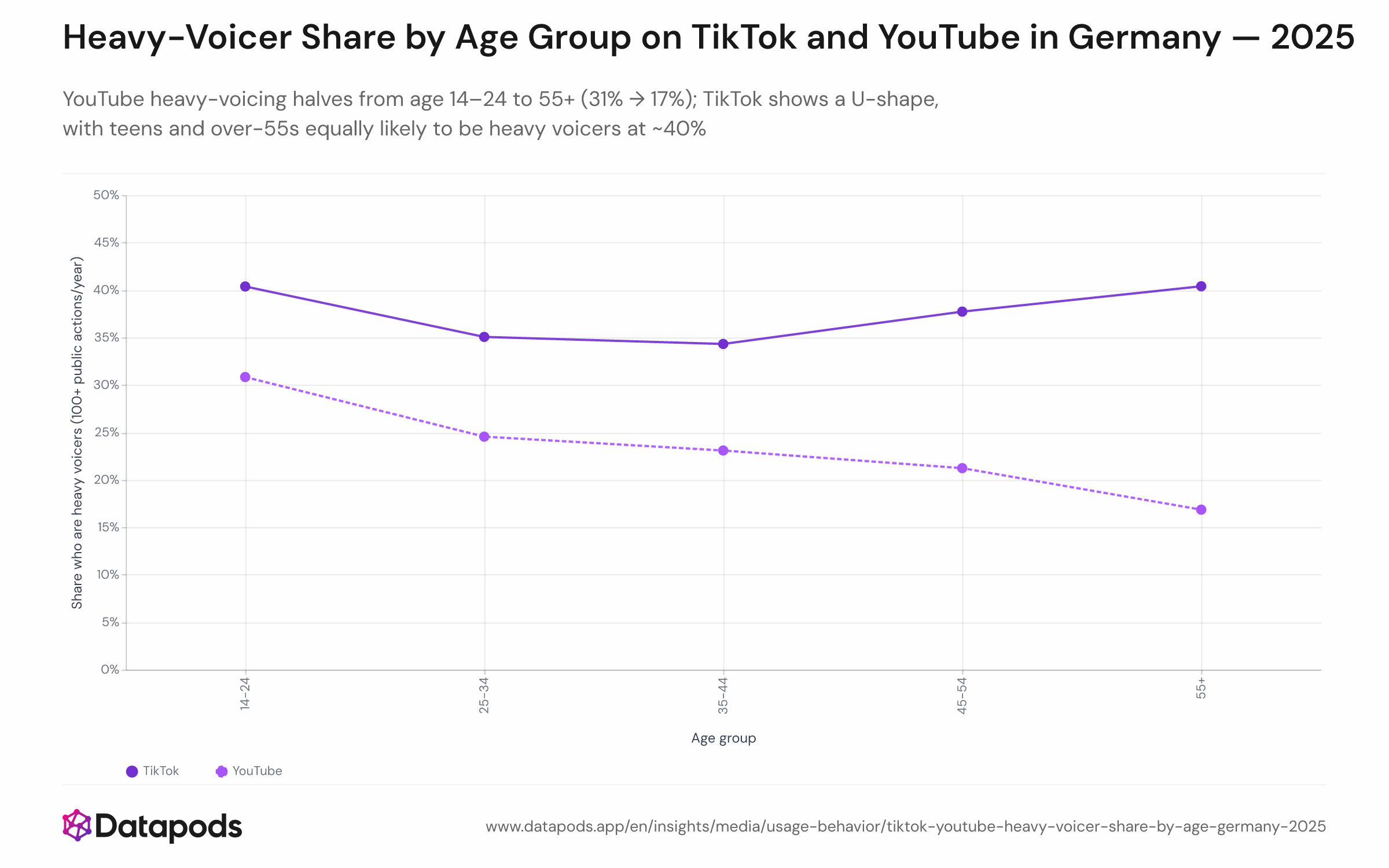
Heavy-Voicer Share by Age Group on TikTok and YouTube in Germany — 2025Line chart showing the share of active German users who are heavy voicers (100+ public actions per year) by age group — 14–24, 25–34, 35–44, 45–54, and 55+ — for both TikTok and YouTube across 2025. YouTube shows a monotonic decline from 31% to 17%; TikTok shows a U-shaped curve from ~40% at 14–24, dipping to ~34% at 25–44, and rising back to ~40% at 55+.Line chart showing the share of active German users who are heavy voicers (100+ public actions per year) by age group — 14–24, 25–34, 35–44, 45–54, and 55+ — for both TikTok and YouTube across 2025. YouTube shows a monotonic decline from 31% to 17%; TikTok shows a U-shaped curve from ~40% at 14–24, dipping to ~34% at 25–44, and rising back to ~40% at 55+.
Line chart showing the share of active German users who are heavy voicers (100+ public actions per year) by age group — 14–24, 25–34, 35–44, 45–54, and 55+ — for both TikTok and YouTube across 2025. YouTube shows a monotonic decline from 31% to 17%; TikTok shows a U-shaped curve from ~40% at 14–24, dipping to ~34% at 25–44, and rising back to ~40% at 55+.
Sample size
n = 36,432
Data date
Full Year 2025
Segment
16-24, 25-34, 35-44, 45-54, 55+
Platform
TikTok, YouTube
Market
Germany
Info
Sample size
n = 36,432
Data date
Full Year 2025
Segment
16-24, 25-34, 35-44, 45-54, 55+
Platform
TikTok, YouTube
Market
Germany

Analysis

TikTok's age-voicing curve is a near-perfect U: both the youngest (14–24) and oldest (55+) active users hit ~40% heavy-voicer share, while the 25–44 cohort dips to ~34%. YouTube runs in the opposite direction — a clean, monotonic decline from 31% at 14–24 to 17% at 55+.

TikTok's algorithm creates equal conditions across generations; YouTube's like culture skews young

YouTube's decline with age matches the broader pattern visible across social platforms: digital nativity and social-validation norms are strongest in younger cohorts, and the path of least resistance — tapping a like — is a behaviour reinforced through years of daily use. Older YouTube users are heavy consumers but lighter reactors, consistent with research showing that over-55 internet users skew toward informational rather than participatory modes of engagement. TikTok's U-shape is more surprising. The 55+ resurgence likely reflects two factors: a self-selected group of older German TikTok users who adopted the platform precisely because of its community features, and TikTok's algorithmically driven feed that surfaces content in niche interest areas — cooking, gardening, nostalgia — where older users respond at high rates. For brands targeting both Gen Z and older demographics on TikTok, the U-shape means neither end of the age spectrum should be treated as a passive audience.


This analysis is based on public segment data. For deeper cuts, use our Enterprise interface.

Related statistics

See all Usage Behavior
  • GfK Consumer Confidence vs. Digital Frugality Signals in Germany — Scatter Plot, Jan 2025–Apr 2026

    Jan 2025–Apr 2026
  • Public Action Concentration Among Voicers on TikTok and YouTube in Germany — 2025

    Full Year 2025
  • TikTok vs. YouTube Engagement Tier Mix by Age Group — 2025

    Full Year 2025
  • Unlock deeper cuts

    Enterprise
See all Usage Behavior

Methodology

Heavy-voicer share was calculated within each age cohort for active German users with a known birth year on each platform. A user was classified as a heavy voicer if they accumulated 100 or more public actions — comments, posts, and shop reviews on TikTok; likes, dislikes, and votes on YouTube — over the full 2025 calendar year. Age groups with fewer than 30 users in either platform's panel were excluded. Cell sizes range from 458 users (TikTok 55+) to 8,424 users (YouTube 25–34), covering a total of 36,432 users across both platforms.


These insights are based on the Datapods Panel. Our data comes exclusively from users who are compensated for their anonymity. Become part of the panel & earn from your data