
Facebook vs. Instagram vs. TikTok: Engagement Depth
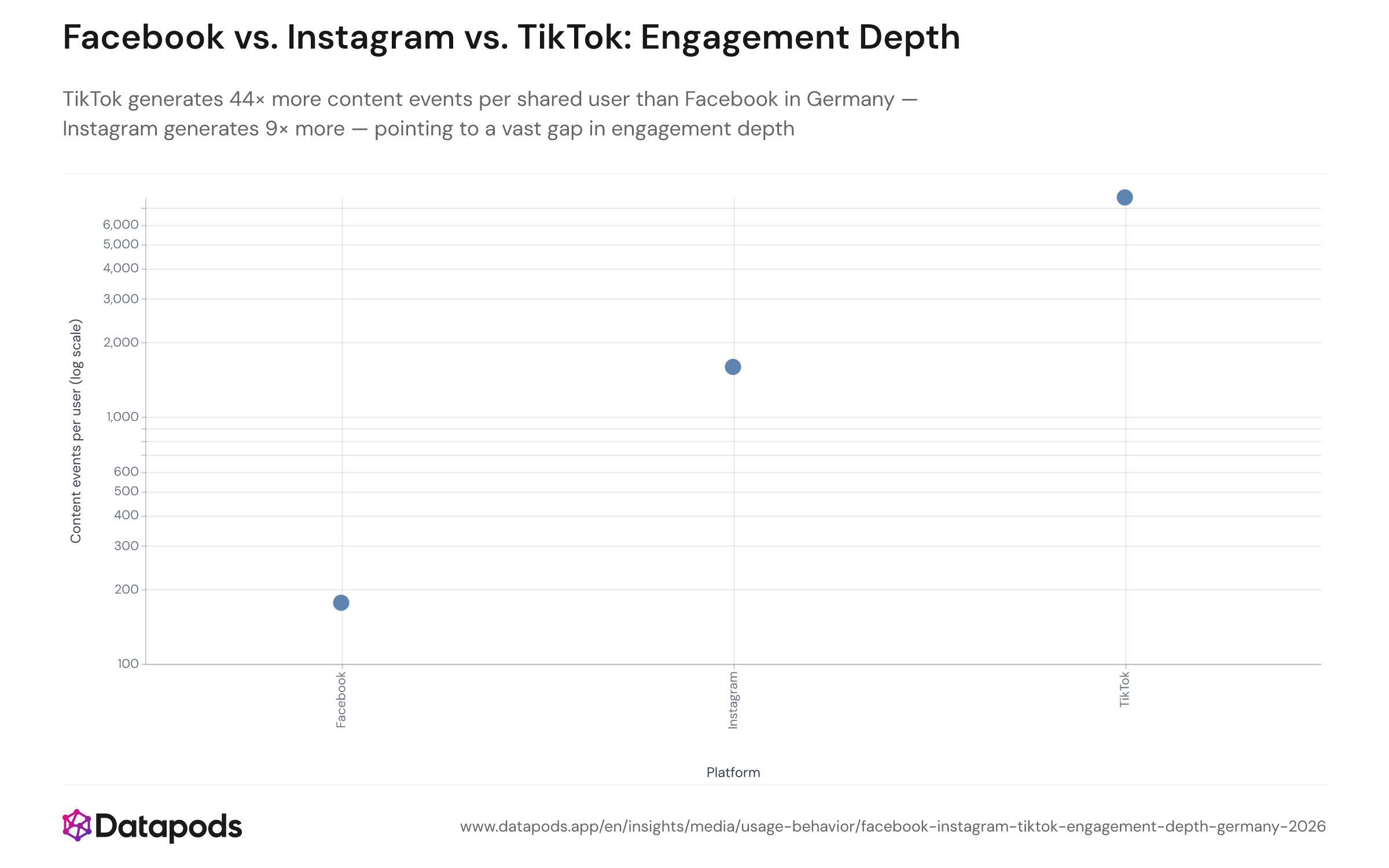
Review June 2026: TikTok generates 44× more content events per shared user than Facebook in Germany — Instagram generates 9× more — pointing to a vast gap in engagement depth
Info
- Sample size
- n = 331
- Data date
- June 2026
- Segment
- All segments
- Platform
- Fb, Ig, TikTok
- Market
- Germany
Analysis
Among German users active on all three platforms in June 2026, Facebook averaged 177 content events per user, Instagram 1,593, and TikTok 7,741. Monthly-active presence was broadly similar across all three — 88.5% on Facebook, 79.5% on Instagram, and 91.5% on TikTok — making the content-volume gap all the more striking.
Platform switching vs. platform substitution
Presence alone does not distinguish how platforms compete for attention. These numbers show that Facebook, Instagram, and TikTok coexist in users' routines but occupy very different places in the daily scroll. TikTok's engagement lead reflects its infinite-scroll, autoplay architecture designed to maximise session depth — a model that has driven its global engagement rate to far outpace Facebook's. The German cross-platform snapshot confirms what engagement benchmarks show broadly: Facebook functions as a high-reach, lower-intensity platform in 2026, while TikTok captures the bulk of active content interaction minutes. For brands, this means Facebook's relevance lies in audience scale and demographic breadth rather than in maximising content touchpoints per session.
This analysis is based on public segment data. For deeper cuts, use our Enterprise interface.
Methodology
The comparison is based on German users tracked as active on all three platforms — Facebook, Instagram, and TikTok — during Q2 2026. June 2026 content-event totals for each platform were divided by this fixed group of 331 users. Content events are platform-specific interactions (feed views on Facebook, following-feed interactions on Instagram, video interactions on TikTok); definitions differ slightly by platform, so multiples should be read as directional magnitude rather than precise ratios. Instagram data is available from January 2026 onward, making this a single-month cross-section rather than a trend.
These insights are based on the Datapods Panel. Our data comes exclusively from users who are compensated for their anonymity. Become part of the panel & earn from your data