
Deep Browsers Convert More — Germany E-Commerce
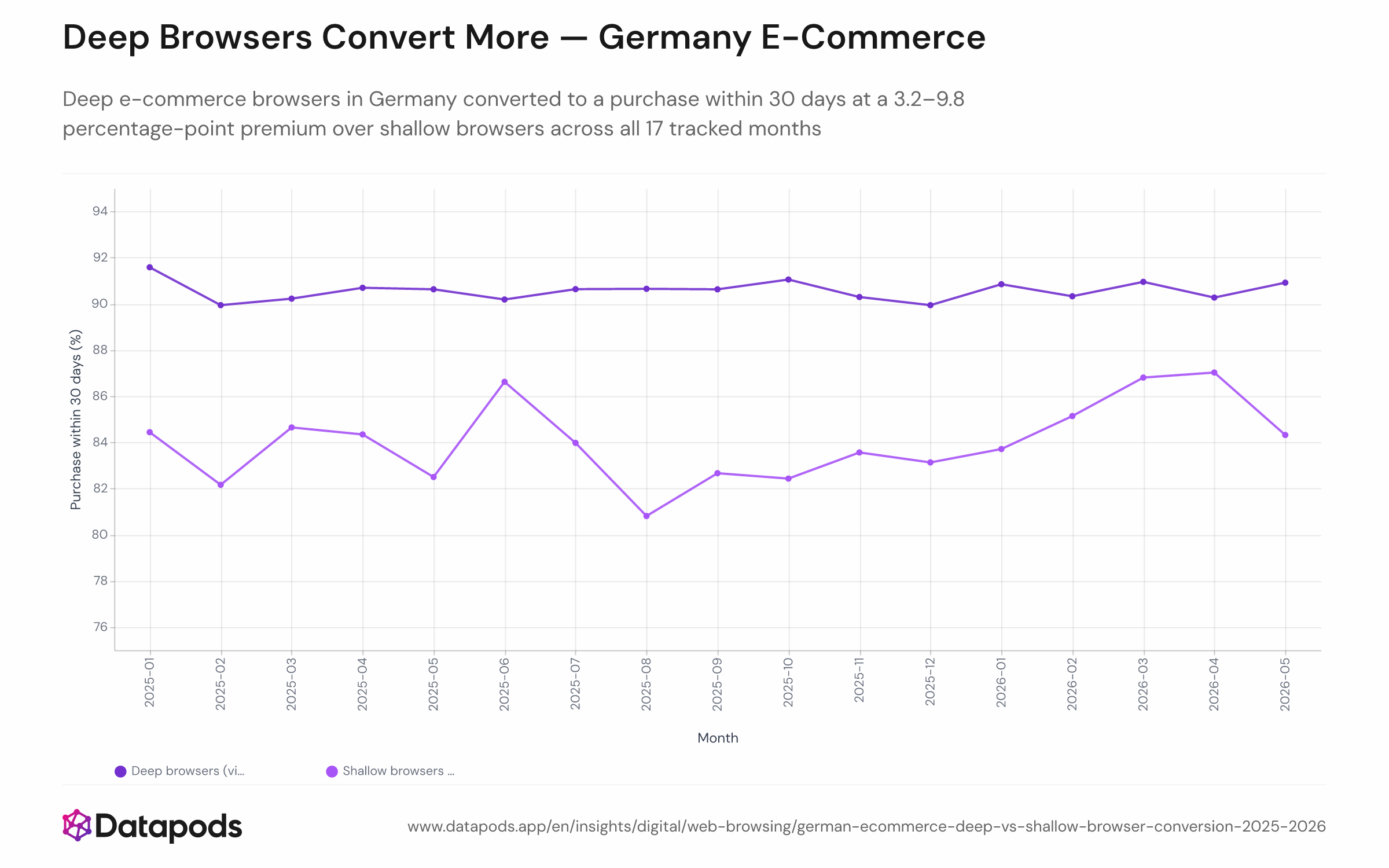
Review Jan 2025 – May 2026: Deep e-commerce browsers in Germany converted to a purchase within 30 days at a 3.2–9.8 percentage-point premium over shallow browsers across all 17 tracked months
Info
- Sample size
- n = 69,553
- Data date
- Jan 2025 – May 2026
- Segment
- All segments
- Platform
- Browsing, Emails
- Market
- Germany
Analysis
In every single month from January 2025 to May 2026, German online shoppers who reached a product-detail or cart-adjacent page converted to a purchase within 30 days at a rate 3.2 to 9.8 percentage points higher than those who visited an e-commerce site without going that deep. The gap held without exception across 17 consecutive months, including the February 2026 demand trough — making browsing depth a highly stable e-commerce intent signal in Germany.
What the browse-to-buy gap means for German e-commerce
The consistent conversion premium reinforces browsing depth as a leading indicator of purchase intent — not merely a measure of site engagement. In the context of Germany's challenging consumer sentiment environment, where the NIM/GfK consumer climate remained well below pre-crisis levels through mid-2026, even a modest recovery in the share of visits reaching product pages carried direct revenue implications. German e-commerce turnover grew 5.1% in Q2 2026 alone according to bevh, and the digital intent data here suggests that shift was visible in browsing behaviour weeks before it appeared in turnover figures. For brands and retailers, closing the gap between shallow and deep browsers — through better product discovery, faster page loads, or AI-driven recommendations — represents one of the clearest levers for revenue growth in Germany's competitive online market. The trend in the share of Germans reaching product pages each month is tracked in the browsing depth overview.
This analysis is based on public segment data. For deeper cuts, use our Enterprise interface.
Methodology
Deep browsers are defined as German adults who viewed at least one product-detail or cart-adjacent page on an e-commerce domain in a given month. Shallow browsers visited an e-commerce site that month without reaching product or cart depth. The 30-day purchase rate measures whether each group completed a purchase in the 30 days following their browsing session, using matched purchase records. Both groups are restricted to users with active coverage in both browsing and email-receipt data, ensuring purchases can be reliably attributed. The observation window runs from January 2025 through May 2026; June 2026 onward is excluded because the 30-day outcome window extends beyond the data refresh cutoff.
These insights are based on the Datapods Panel. Our data comes exclusively from users who are compensated for their anonymity. Become part of the panel & earn from your data