
Where REWE Shoppers Browse Beyond REWE
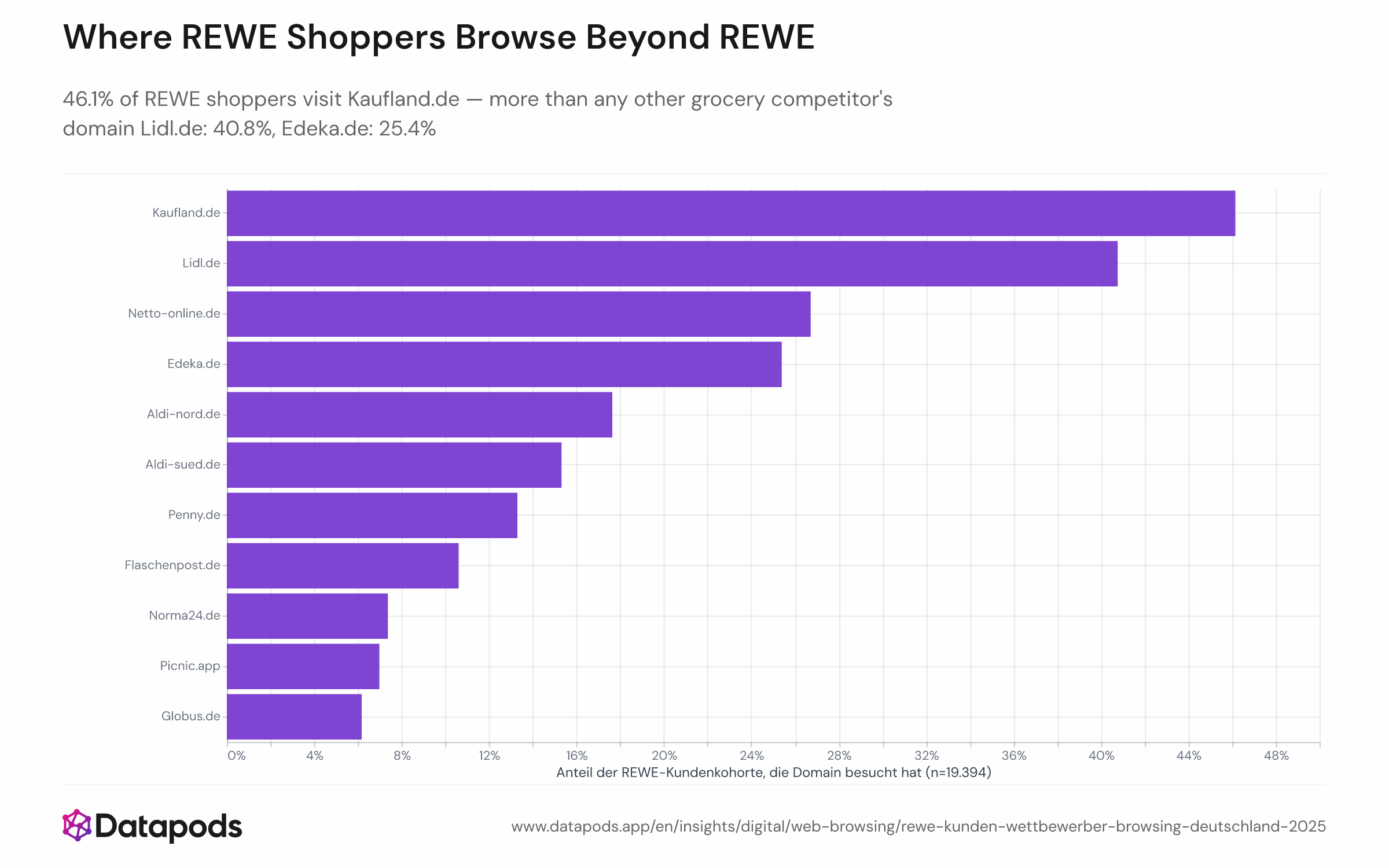
Review Jan 2025 – Jul 2026: 46.1% of REWE shoppers visit Kaufland.de — more than any other grocery competitor's domain Lidl.de: 40.8%, Edeka.de: 25.4%
Info
- Sample size
- n = 19,394
- Data date
- Jan 2025 – Jul 2026
- Segment
- All segments
- Platform
- Browsing
- Market
- Germany
Analysis
Nearly half of all REWE shoppers in Germany actively visit Kaufland.de, a rival that REWE's own checkout data can never reveal. The gap between Kaufland.de (46.1%) and Edeka.de (25.4%) is striking: despite Edeka being REWE's closest full-range competitor by revenue and store format, it ranks far behind Kaufland and Lidl in the browsing habits of REWE's own customer base.
The Schwarz Group's digital pull on REWE shoppers
Kaufland and Lidl — both owned by the Schwarz Group — together account for the top two competitor domains visited by REWE shoppers, and their combined digital reach dwarfs that of EDEKA online. This reflects a broader market dynamic: by 2025, the Schwarz Group operates over 4,000 domestic locations across Germany, and Kaufland's ongoing omnichannel push, including a loyalty-linked app and extended store hours, has made its website a regular destination for price-comparison and weekly-offer browsing. Lidl's high-profile 2025 price campaign — which courts later ruled "misleading" but which reshaped industry price communication — drove heavy website traffic and reinforced the habit of checking Lidl.de first. For REWE strategists, the data exposes a blind spot: their core customers are comparison-shopping with Schwarz Group properties far more intensively than with EDEKA, a competitive threat invisible to any first-party data source. See also the cross-shopping picture among verified buyers in REWE shoppers' cross-shopping with EDEKA and Netto.
This analysis is based on public segment data. For deeper cuts, use our Enterprise interface.
Methodology
The REWE shopper cohort covers German online users identified as REWE customers through any of three signals — visits to rewe.de, use of the REWE app on Android or iOS, or a verified REWE purchase — recorded between January 2025 and July 2026. Competitor domain reach is measured as the share of cohort members who visited each retailer's website at least once within the same period. Domains are mapped to grocery brands using a standardised brand-to-domain reference, so subdomains and microsites roll up to the parent retailer.
These insights are based on the Datapods Panel. Our data comes exclusively from users who are compensated for their anonymity. Become part of the panel & earn from your data