Datapods|Insights
Consumption
Online ShoppingProduct CategoriesRetailSocial Commerce
Digital
Web & BrowsingSearch QueriesApps & MobileAdvertising
Media
Video & StreamingSocial MediaTrends & TopicsUsage Behavior
Blog|For BusinessFor Consumers
Datapods|Insights
ConsumptionOnline ShoppingProduct CategoriesRetailSocial CommerceDigitalWeb & BrowsingSearch QueriesApps & MobileAdvertisingMediaVideo & StreamingSocial MediaTrends & TopicsUsage BehaviorBlogFor BusinessFor Consumers
InsightsDigitalSearch Queries
Datapods

Talk to people who actually bought your product.

Use Cases

  • Churn & Win-Back
  • Product & Concept Testing
  • Ad & Creative Testing
  • Customer Journey
  • Competitive Intelligence
  • Audiences & Segmentation
  • Influencers & Creators

Industries

  • Grocery & Drugstore
  • CPG & Brands
  • E-Commerce & Marketplaces
  • Telco & Subscriptions
  • Media & Streaming
  • Apps & Digital

Platform

  • AI Research Agent
  • AI Interviewer
  • Quant Surveys
  • Audience Builder
  • Data API
  • Social Attribution

Company

  • Home
  • About
  • For Consumers
  • The Datapods Panel
  • Insights
  • Contact
  • Blog

Legal

  • Imprint
  • Privacy Policy
  • User Agreement App
  • Privacy Policy App
  • User Agreement Platform
  • Privacy Policy Platform
  • Cookie Policy

©2026 Datapods.app. All rights reserved.

EU Co-financedNRW

Heat Pump vs. Gas Boiler Search Share by Urbanization in Germany — 2024 to 2026

Results as of 06.05.2026

Review Jan 2024 – Mar 2026: Rural users devote 25.8% of their heating searches to Wärmepumpe — more than double the 11.2% share of metropolitan users, inverting the urban-progressive cliché of the Energiewende
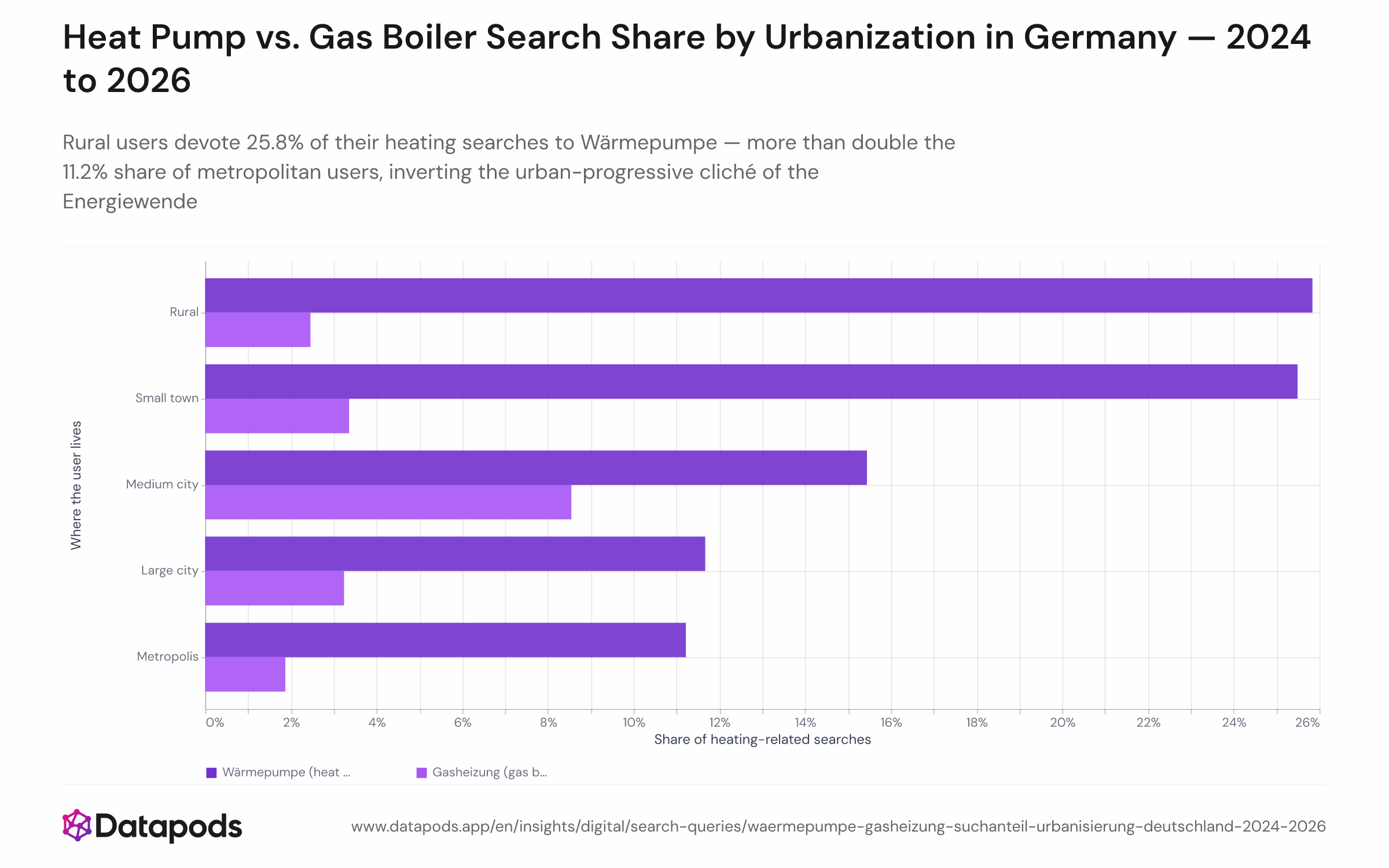
Heat Pump vs. Gas Boiler Search Share by Urbanization in Germany — 2024 to 2026Grouped bar chart showing the share of heating-related Google searches mentioning Wärmepumpe and Gasheizung across five urbanization segments (Rural, Small town, Medium city, Large city, Metropolis) in Germany, aggregated from January 2024 to March 2026. Wärmepumpe bars decline from 25.8% in rural areas to 11.2% in metropolises; Gasheizung bars peak at 8.5% in medium cities and fall to 1.9% in metropolises.Grouped bar chart showing the share of heating-related Google searches mentioning Wärmepumpe and Gasheizung across five urbanization segments (Rural, Small town, Medium city, Large city, Metropolis) in Germany, aggregated from January 2024 to March 2026. Wärmepumpe bars decline from 25.8% in rural areas to 11.2% in metropolises; Gasheizung bars peak at 8.5% in medium cities and fall to 1.9% in metropolises.
Grouped bar chart showing the share of heating-related Google searches mentioning Wärmepumpe and Gasheizung across five urbanization segments (Rural, Small town, Medium city, Large city, Metropolis) in Germany, aggregated from January 2024 to March 2026. Wärmepumpe bars decline from 25.8% in rural areas to 11.2% in metropolises; Gasheizung bars peak at 8.5% in medium cities and fall to 1.9% in metropolises.
Sample size
n = 742
Data date
Jan 2024 – Mar 2026
Segment
All segments
Platform
Search, Survey
Market
Germany
Info
Sample size
n = 742
Data date
Jan 2024 – Mar 2026
Segment
All segments
Platform
Search, Survey
Market
Germany

Analysis

Rural Germans (25.8%) and small-town Germans (25.5%) allocate more than a quarter of their heating searches to Wärmepumpe — over twice the rate seen in large cities (11.7%) and metropolitan areas (11.2%). The Energiewende's actual search audience for heat pumps lives outside urban Germany, not inside it.

Why single-family-house geography determines heat-pump intent

The explanation is structural: rural and small-town Germany is dominated by detached and semi-detached single-family homes where the homeowner controls the heating decision, has outdoor space for a unit, and faces no shared building rules. Data from Germany's property market show that the smaller the municipality, the higher the rate of heat pump adoption — a pattern directly mirrored in search behaviour. Gasheizung interest runs the opposite way: its highest search share appears in medium-sized cities (8.5%), where mid-tier housing is densely connected to gas distribution grids and multi-unit buildings make a shared system switch complicated. The 2025 sales data add market confirmation: rented and multi-unit urban housing kept gas boiler demand alive in cities even as the overall gas boiler market fell 33% year-on-year. For marketers and installers, the geographic skew means the Wärmepumpe audience is concentrated in postal codes, not city centres.


This analysis is based on public segment data. For deeper cuts, use our Enterprise interface.

Related statistics

See all Search Queries
  • BYD vs. Tesla & VW Search Click-Through Destinations in Germany — 2025–2026

    Jan 2025 – Jun 2026
  • BYD Search Interest by Age Group in Germany — 2025–2026

    Jan 2025 – Jun 2026
  • AI Tool Share in German Google Product Searches: ChatGPT, Gemini, Perplexity — 2025 to Q1 2026

    2025 – Q1 2026
  • Unlock deeper cuts

    Enterprise
See all Search Queries

Methodology

From the broader cohort of heating searchers, individuals who completed a demographic survey question on residential area type were assigned to one of five segments: Rural, Small town, Medium city, Large city, or Metropolis. Around 742 individuals with a valid area-type response are included, accounting for roughly half of the overall heating-searcher cohort. Each segment's Wärmepumpe and Gasheizung shares are calculated as a fraction of that segment's total heating searches between January 2024 and March 2026. Total heating searches by segment: Rural (approx. 1,670), Small town (approx. 1,220), Medium city (approx. 670), Large city (approx. 620), Metropolis (approx. 320). Metropolis figures are the smallest cell and should be treated as directional.


These insights are based on the Datapods Panel. Our data comes exclusively from users who are compensated for their anonymity. Become part of the panel & earn from your data