
Wallbox & EV Charging Engagement on Amazon.de
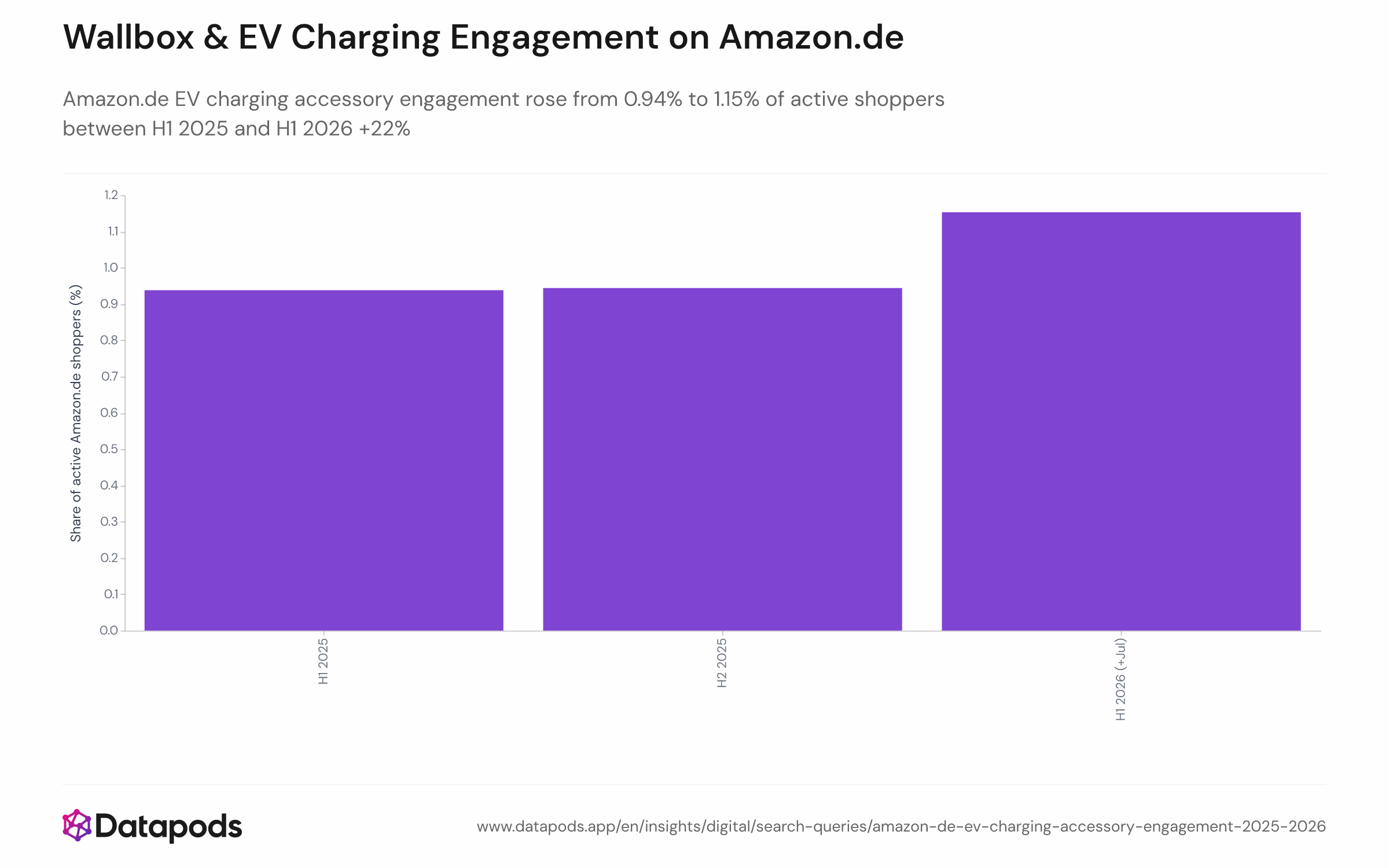
Review H1 2025 – H1 2026: Amazon.de EV charging accessory engagement rose from 0.94% to 1.15% of active shoppers between H1 2025 and H1 2026 +22%
Info
- Sample size
- n = 12,923
- Data date
- H1 2025 – H1 2026
- Segment
- All segments
- Platform
- Browsing, Purchases
- Market
- Germany
Analysis
The share of active Amazon.de shoppers who viewed or purchased a wallbox, EV charging cable, or charging adapter grew from 0.94% in the first half of 2025 to 1.15% in the first half of 2026 — a 22% relative increase that tracks the broader wave of EV consideration in Germany.
Ladeinfrastruktur follows EV adoption
The uplift is consistent with a German EV market that expanded by 48% in the first half of 2026, reaching a 25% share of total new car registrations. As more German households take delivery of their first electric vehicle — and as a new federal EV subsidy programme covering up to €6,000 has been active since January 2026 — demand for home-charging infrastructure logically follows. A separate federal initiative with a €500 million budget for charging infrastructure in multi-family buildings launched in April 2026, further stimulating awareness of wallbox purchases. This signal is directional: the engaged shopper base on Amazon.de remains a small fraction of the overall EV-consideration population identified in the monthly EV search reach data, confirming that most purchase research still occurs at search and automotive-classifieds level.
This analysis is based on public segment data. For deeper cuts, use our Enterprise interface.
Methodology
Share of active Amazon.de shoppers (those who visited at least one product page on amazon.de during the period) who engaged with EV charging products — defined as either viewing a product page or completing a purchase for wallboxes, Type-2 charging cables, EV charging adapters, or home EV charging stations on Amazon.de. Consumer-electronics chargers, phone accessories, and unrelated products surfacing on false-positive keyword matches were manually identified and excluded. Three half-year periods are shown: H1 2025, H2 2025, and H1 2026 (the latter extended to include July 2026).