
EV Search Query Mix: Subsidies Surge in 2026
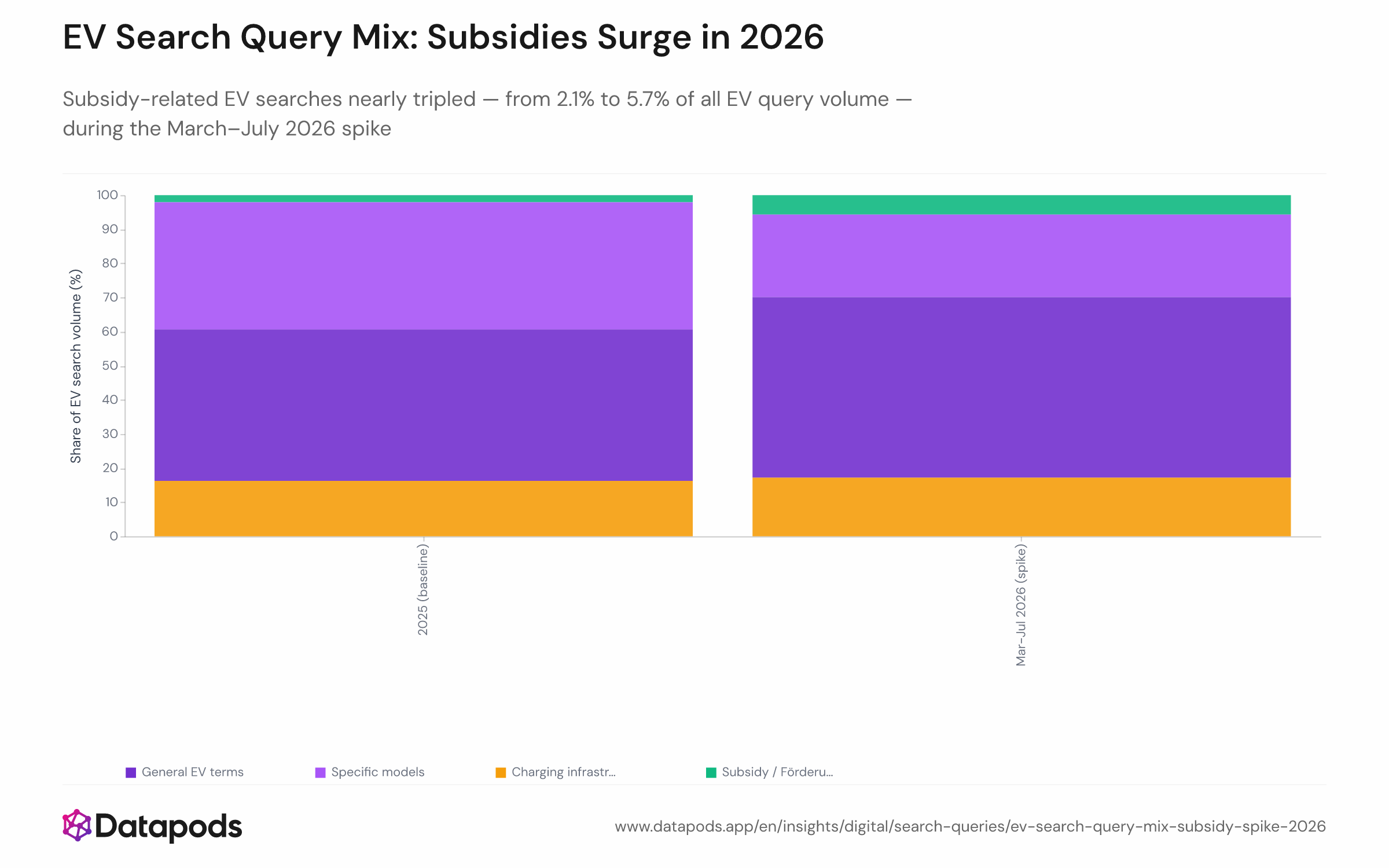
Review 2025 baseline vs. Mar–Jul 2026: Subsidy-related EV searches nearly tripled — from 2.1% to 5.7% of all EV query volume — during the March–July 2026 spike
Info
- Sample size
- n = 7,909
- Data date
- 2025 baseline vs. Mar–Jul 2026
- Segment
- All segments
- Platform
- Search
- Market
- Germany
Analysis
When Germans searched for electric vehicles during the 2026 fuel-price shock, they searched differently: the share of EV queries focused on subsidies and grants nearly tripled, climbing from 2.1% in 2025 to 5.7% of all EV-related query volume in March–July 2026.
Germany's new EV grant meets the fuel-price moment
The timing is doubly significant. Germany's federal government relaunched EV purchase subsidies in January 2026, offering up to €6,000 for income-eligible private buyers, with the online application portal opening in May 2026. Within ten weeks of opening, over 100,000 applications had been filed with BAFA — around 90% for pure battery-electric vehicles. The spike in subsidy-related searches therefore captures two overlapping forces: existing EV buyers racing to claim grants retroactively, and newly interested consumers — many of them older, as shown in the age-group index chart — calculating whether switching to an EV makes financial sense as fuel costs hit record levels. The composition shift toward subsidy queries signals that cost, not just environmental interest, is now the dominant frame of EV consideration in Germany.
This analysis is based on public segment data. For deeper cuts, use our Enterprise interface.
Methodology
Share of total EV-related Google search query events (by raw event count) falling into each topic bucket — general EV interest, specific model searches (including Skoda Elroq and VW ID series), charging infrastructure, and subsidy/grant queries — for two periods: the full-year 2025 baseline (20,913 query events) and the March–July 2026 spike window (7,909 query events). Topic buckets are mutually exclusive, assigned by regex-match precedence (subsidy queries take priority, then model-specific, then charging, then general). Shares reflect the composition of EV-query intent, not population reach.