Datapods|Insights
Consumption
Online ShoppingProduct CategoriesRetailSocial Commerce
Digital
Web & BrowsingSearch QueriesApps & MobileAdvertising
Media
Video & StreamingSocial MediaTrends & TopicsUsage Behavior
Blog|For BusinessFor Consumers
Datapods|Insights
ConsumptionOnline ShoppingProduct CategoriesRetailSocial CommerceDigitalWeb & BrowsingSearch QueriesApps & MobileAdvertisingMediaVideo & StreamingSocial MediaTrends & TopicsUsage BehaviorBlogFor BusinessFor Consumers
InsightsDigitalSearch Queries
Datapods

Talk to people who actually bought your product.

Use Cases

  • Churn & Win-Back
  • Product & Concept Testing
  • Ad & Creative Testing
  • Customer Journey
  • Competitive Intelligence
  • Audiences & Segmentation
  • Influencers & Creators

Industries

  • Grocery & Drugstore
  • CPG & Brands
  • E-Commerce & Marketplaces
  • Telco & Subscriptions
  • Media & Streaming
  • Apps & Digital

Platform

  • AI Research Agent
  • AI Interviewer
  • Quant Surveys
  • Audience Builder
  • Data API
  • Social Attribution

Company

  • Home
  • About
  • For Consumers
  • The Datapods Panel
  • Insights
  • Contact
  • Blog

Legal

  • Imprint
  • Privacy Policy
  • User Agreement App
  • Privacy Policy App
  • User Agreement Platform
  • Privacy Policy Platform
  • Cookie Policy

©2026 Datapods.app. All rights reserved.

EU Co-financedNRW

DSDS 2026 Finale YouTube Watch Share by Age Group in Germany — May 9–10, 2026

Results as of 21.05.2026

Review May 9–10, 2026 vs. May 4–8 baseline: 55–64 year-olds drove the largest DSDS 2026 YouTube watch spike at 5.9× above baseline — while 16–24 year-olds barely reacted (1.7×) largest cross-age gap of any DSDS metric
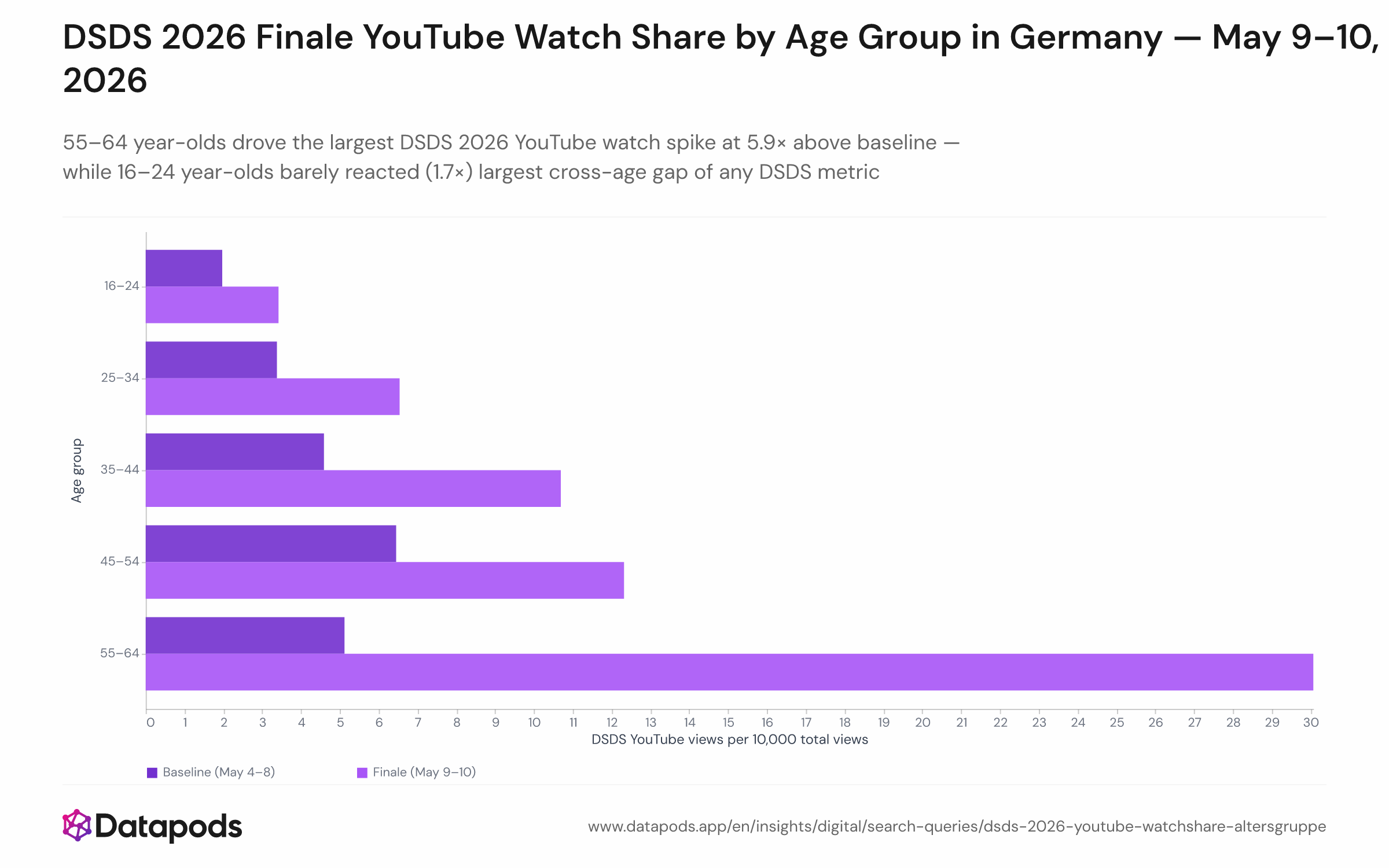
DSDS 2026 Finale YouTube Watch Share by Age Group in Germany — May 9–10, 2026Grouped bar chart showing DSDS 2026 YouTube watch share (per 10,000 total watch actions) for five age groups (16–24, 25–34, 35–44, 45–54, 55–64), comparing the quiet-day baseline (May 4–8) with the finale weekend (May 9–10). The 55–64 group shows the tallest finale bar at 30.1 bps; the 16–24 group shows the smallest increase (2.0 to 3.4 bps).Grouped bar chart showing DSDS 2026 YouTube watch share (per 10,000 total watch actions) for five age groups (16–24, 25–34, 35–44, 45–54, 55–64), comparing the quiet-day baseline (May 4–8) with the finale weekend (May 9–10). The 55–64 group shows the tallest finale bar at 30.1 bps; the 16–24 group shows the smallest increase (2.0 to 3.4 bps).
Grouped bar chart showing DSDS 2026 YouTube watch share (per 10,000 total watch actions) for five age groups (16–24, 25–34, 35–44, 45–54, 55–64), comparing the quiet-day baseline (May 4–8) with the finale weekend (May 9–10). The 55–64 group shows the tallest finale bar at 30.1 bps; the 16–24 group shows the smallest increase (2.0 to 3.4 bps).
Sample size
n = 14,956
Data date
May 9–10, 2026 vs. May 4–8 baseline
Segment
16-24, 25-34, 35-44, 45-54, 55+
Platform
Browsing, Search
Market
Germany
Info
Sample size
n = 14,956
Data date
May 9–10, 2026 vs. May 4–8 baseline
Segment
16-24, 25-34, 35-44, 45-54, 55+
Platform
Browsing, Search
Market
Germany

Analysis

YouTube watch engagement with DSDS content shows the sharpest age gradient of any metric in the 2026 analysis. The 55–64 cohort went from 5.1 bps baseline to 30.1 bps on the finale weekend (5.9×), while 35–44 reached 10.7 bps (2.3×) and 45–54 hit 12.3 bps (1.9×). The 16–24 group's share barely shifted — 2.0 bps to 3.4 bps (1.7×). Critically, the overall YouTube response was more muted than search across all age groups, pointing to a post-broadcast catch-up pattern rather than live, social-media-style engagement.

Older viewers turn to YouTube; younger audiences don't bother

The 2026 DSDS season was only 10 episodes long and broadcast exclusively on RTL and RTL+, with no mainstream free-to-air streaming integration. For older viewers who may have missed the live finale, YouTube served as the primary catch-up destination for highlight clips, reaction videos, and post-finale controversy content — all of which surged in the days after May 9. For 16–24 year-olds, DSDS content likely competed poorly with algorithmically served entertainment on YouTube itself and with TikTok, which dominates short-form attention in that cohort. The weak YouTube signal from younger audiences does not reflect low awareness of the event — their search spike shows they knew about it — but rather a clear difference in how generations consume post-broadcast content.


This analysis is based on public segment data. For deeper cuts, use our Enterprise interface.

Related statistics

See all Search Queries
  • BYD vs. Tesla & VW Search Click-Through Destinations in Germany — 2025–2026

    Jan 2025 – Jun 2026
  • Unlock deeper cuts

    Enterprise
  • BYD Search Interest by Age Group in Germany — 2025–2026

    Jan 2025 – Jun 2026
  • AI Tool Share in German Google Product Searches: ChatGPT, Gemini, Perplexity — 2025 to Q1 2026

    2025 – Q1 2026
See all Search Queries

Methodology

The metric is the share of YouTube video watch actions containing DSDS-related terms in the video title per 10,000 total YouTube watch actions, computed separately for each age group (16–24 to 55–64). Only organic watch actions are included (excluding ads). The finale weekend is May 9–10, 2026; the baseline is the average of May 4–8, 2026. Age is derived from user birth year. The analysis covers German online users aged 16–64.


These insights are based on the Datapods Panel. Our data comes exclusively from users who are compensated for their anonymity. Become part of the panel & earn from your data