Datapods|Insights
Consumption
Online ShoppingProduct CategoriesRetailSocial Commerce
Digital
Web & BrowsingSearch QueriesApps & MobileAdvertising
Media
Video & StreamingSocial MediaTrends & TopicsUsage Behavior
Blog|For BusinessFor Consumers
Datapods|Insights
ConsumptionOnline ShoppingProduct CategoriesRetailSocial CommerceDigitalWeb & BrowsingSearch QueriesApps & MobileAdvertisingMediaVideo & StreamingSocial MediaTrends & TopicsUsage BehaviorBlogFor BusinessFor Consumers
InsightsConsumptionRetail
Datapods

Talk to people who actually bought your product.

Use Cases

  • Churn & Win-Back
  • Product & Concept Testing
  • Ad & Creative Testing
  • Customer Journey
  • Competitive Intelligence
  • Audiences & Segmentation
  • Influencers & Creators

Industries

  • Grocery & Drugstore
  • CPG & Brands
  • E-Commerce & Marketplaces
  • Telco & Subscriptions
  • Media & Streaming
  • Apps & Digital

Platform

  • AI Research Agent
  • AI Interviewer
  • Quant Surveys
  • Audience Builder
  • Data API
  • Social Attribution

Company

  • Home
  • About
  • For Consumers
  • The Datapods Panel
  • Insights
  • Contact
  • Blog

Legal

  • Imprint
  • Privacy Policy
  • User Agreement App
  • Privacy Policy App
  • User Agreement Platform
  • Privacy Policy Platform
  • Cookie Policy

©2026 Datapods.app. All rights reserved.

EU Co-financedNRW

Price-Comparison Site Reach by Age Group Among German Online Shoppers — 2025 to Q1 2026

Results as of 01.05.2026

Review 2025 – Q1 2026: Price-comparison reach peaked across all age groups in H2 2025 — the 35–44 cohort led at 48.7% — then retreated uniformly by 4–8pp in Q1 2026
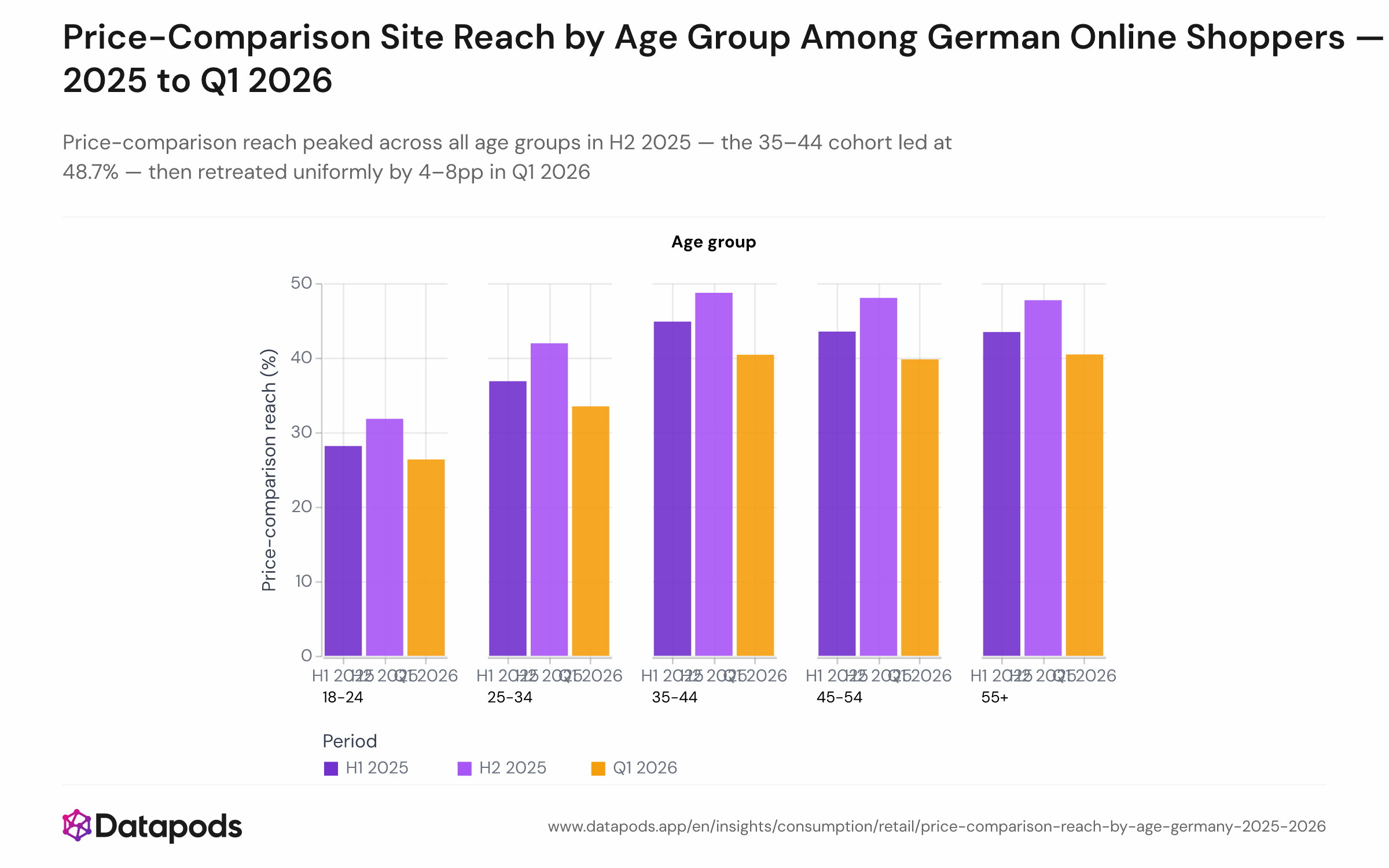
Price-Comparison Site Reach by Age Group Among German Online Shoppers — 2025 to Q1 2026Grouped bar chart showing price-comparison site reach by age group (18–24, 25–34, 35–44, 45–54, 55+) across three periods: H1 2025, H2 2025, and Q1 2026. Each group shows a peak in H2 2025 followed by a decline in Q1 2026. The 35–44 cohort records the highest H2 2025 reach at 48.7%; the 18–24 cohort records the lowest at roughly 28–32% across all periods.Grouped bar chart showing price-comparison site reach by age group (18–24, 25–34, 35–44, 45–54, 55+) across three periods: H1 2025, H2 2025, and Q1 2026. Each group shows a peak in H2 2025 followed by a decline in Q1 2026. The 35–44 cohort records the highest H2 2025 reach at 48.7%; the 18–24 cohort records the lowest at roughly 28–32% across all periods.
Grouped bar chart showing price-comparison site reach by age group (18–24, 25–34, 35–44, 45–54, 55+) across three periods: H1 2025, H2 2025, and Q1 2026. Each group shows a peak in H2 2025 followed by a decline in Q1 2026. The 35–44 cohort records the highest H2 2025 reach at 48.7%; the 18–24 cohort records the lowest at roughly 28–32% across all periods.
Sample size
n = 42,803
Data date
2025 – Q1 2026
Segment
All segments
Platform
Browsing
Market
Germany
Info
Sample size
n = 42,803
Data date
2025 – Q1 2026
Segment
All segments
Platform
Browsing
Market
Germany

Analysis

Across every age cohort, price-comparison site reach climbed steadily through the first half of 2025 and crested in the second half — 35–44 year-olds hit 48.7%, 45–54 hit 48.0%, and 55+ hit 47.7%. Younger shoppers aged 18–24 showed the lowest baseline at just 28–32% throughout, a gap that held stable across the entire period.

A uniform retreat rules out a cohort story

The Q1 2026 pullback of 4–8 percentage points hit every age group equally, which is the finding's most consequential detail for retail marketers and analysts tracking Sparverhalten im Onlinehandel. If the retreat were confidence-driven, older or more financially cautious cohorts would have held or increased usage. Instead, the synchronized contraction points to a broader behavioral shift — possibly reflecting a change in how shoppers use price-comparison tools relative to search and social discovery — rather than any one demographic losing faith in the Preisvergleich habit. The overall price-comparison reach trend provides the full monthly context behind these half-year snapshots.


This analysis is based on public segment data. For deeper cuts, use our Enterprise interface.

Related statistics

See all Retail
  • OLYMP and Seidensticker Browsing Share Among German Online Users — Jan 2025–May 2026

    Jan 2025 – May 2026
  • Unlock deeper cuts

    Enterprise
  • OLYMP and Seidensticker Browsing Shift Among Prior Eterna Visitors in Germany — After March 2026 Insolvency Announcement

    3 months pre vs. post March 2026
  • Age Distribution of Eterna.de Visitors in Germany vs. Panel Baseline — 2025–2026

    Jan 2025 – May 2026
See all Retail

Methodology

For each six-month period (H1 2025, H2 2025, Q1 2026), the share of active German online shoppers in each age group who visited at least one major price-comparison portal was calculated. Age groups are based on birth year. Shoppers without a recorded birth year were excluded. Active shoppers are those with any recorded browsing activity in the relevant period. Q1 2026 covers January through March (complete months only). Each age-period cell contains between approximately 1,100 and 5,100 participants.


These insights are based on the Datapods Panel. Our data comes exclusively from users who are compensated for their anonymity. Become part of the panel & earn from your data