
Amazon.de Order Value vs. Price-Comparison Intensity by Age Group in Germany — 2025 to Apr 2026
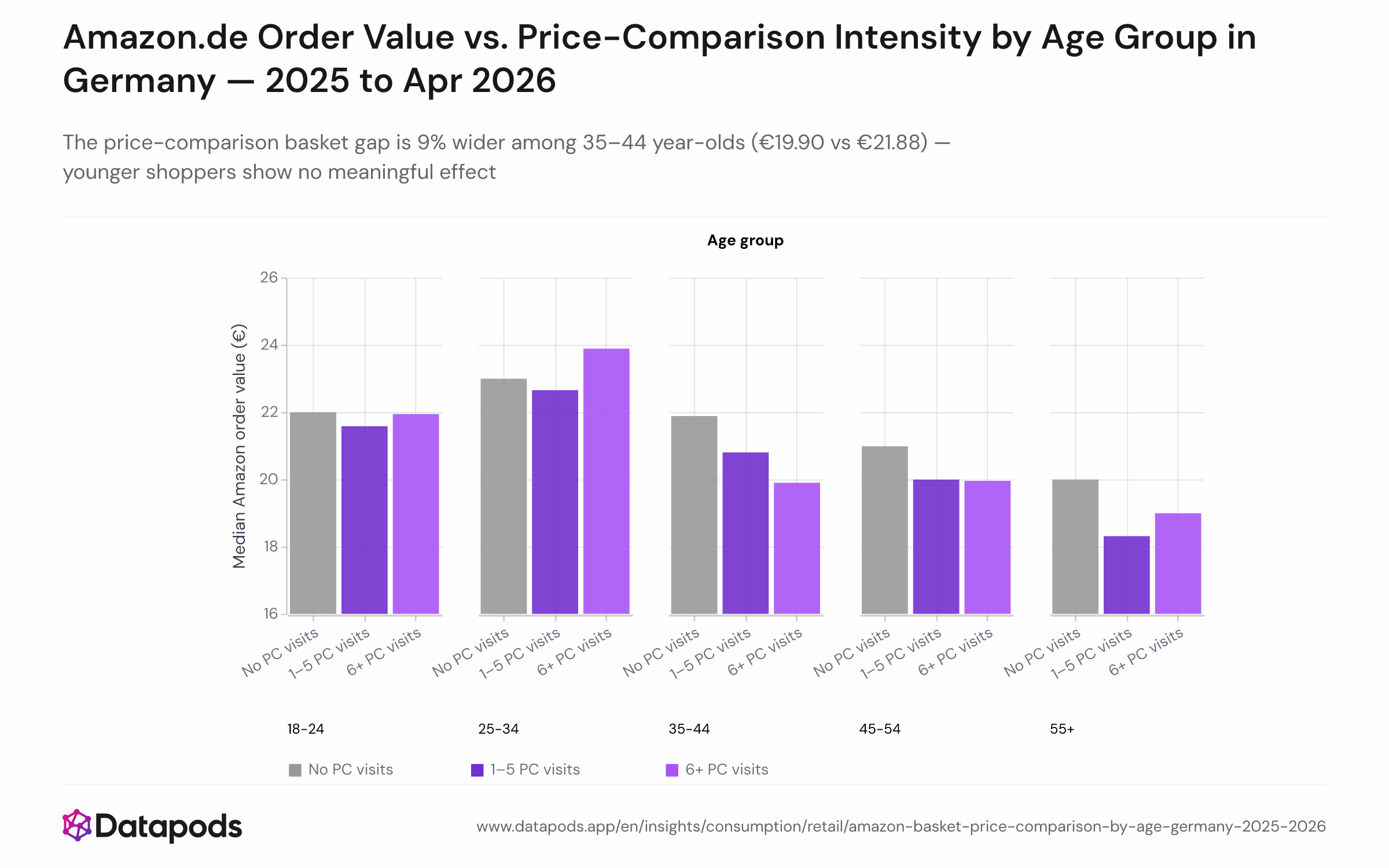
Review Jan 2025 – Apr 2026: The price-comparison basket gap is 9% wider among 35–44 year-olds (€19.90 vs €21.88) — younger shoppers show no meaningful effect
Info
- Sample size
- n = 10,117
- Data date
- Jan 2025 – Apr 2026
- Segment
- All segments
- Platform
- Amazon, Browsing
- Market
- Germany
Analysis
The 5.2% overall gap between heavy price-comparers and non-comparers on Amazon.de (see the overall basket analysis) is not evenly distributed across German shoppers. Among 35–44 year-olds, heavy comparers have a median Amazon basket of €19.90 versus €21.88 for non-comparers — a 9.0% gap. The 45–54 cohort shows a 4.9% gap (€19.95 vs. €20.98), and 55+ shows a 5.0% gap (€18.99 vs. €19.99). But for shoppers aged 18–24 and 25–34, basket size is essentially flat across all price-comparison intensity levels.
Why the Effect Is Concentrated in 35–54-Year-Olds
Mid-career German consumers are the demographic most likely to combine habitual high-frequency Amazon purchasing with deliberate discount browsing behavior — a pattern consistent with BCG's 2025 finding that up to 70% of German purchase decisions are influenced by discounts. Younger shoppers, who rely more on social discovery and tend toward lower absolute spend, show no detectable price-optimization penalty on basket size. For German e-commerce and retail strategy, the 35–54 segment represents both the highest Preisvergleich sensitivity and the highest baseline order frequency — making price-comparison visibility critical for winning their category-level attention.
This analysis is based on public segment data. For deeper cuts, use our Enterprise interface.
Methodology
For each shopper-month, the median Amazon.de physical order value was calculated and broken down by age group (18–24, 25–34, 35–44, 45–54, 55+) and by price-comparison site visit intensity (none, light 1–5 visits, heavy 6+ visits). Orders above €1,000 were excluded. Age is based on birth year; shoppers without a recorded birth year were excluded. The analysis covers physical orders on the German Amazon marketplace from January 2025 through April 2026. The smallest age-intensity cell (18–24, heavy) contains 193 shopper-months from 87 individuals.
These insights are based on the Datapods Panel. Our data comes exclusively from users who are compensated for their anonymity. Become part of the panel & earn from your data