
Emergency App Retention After Warntag Install
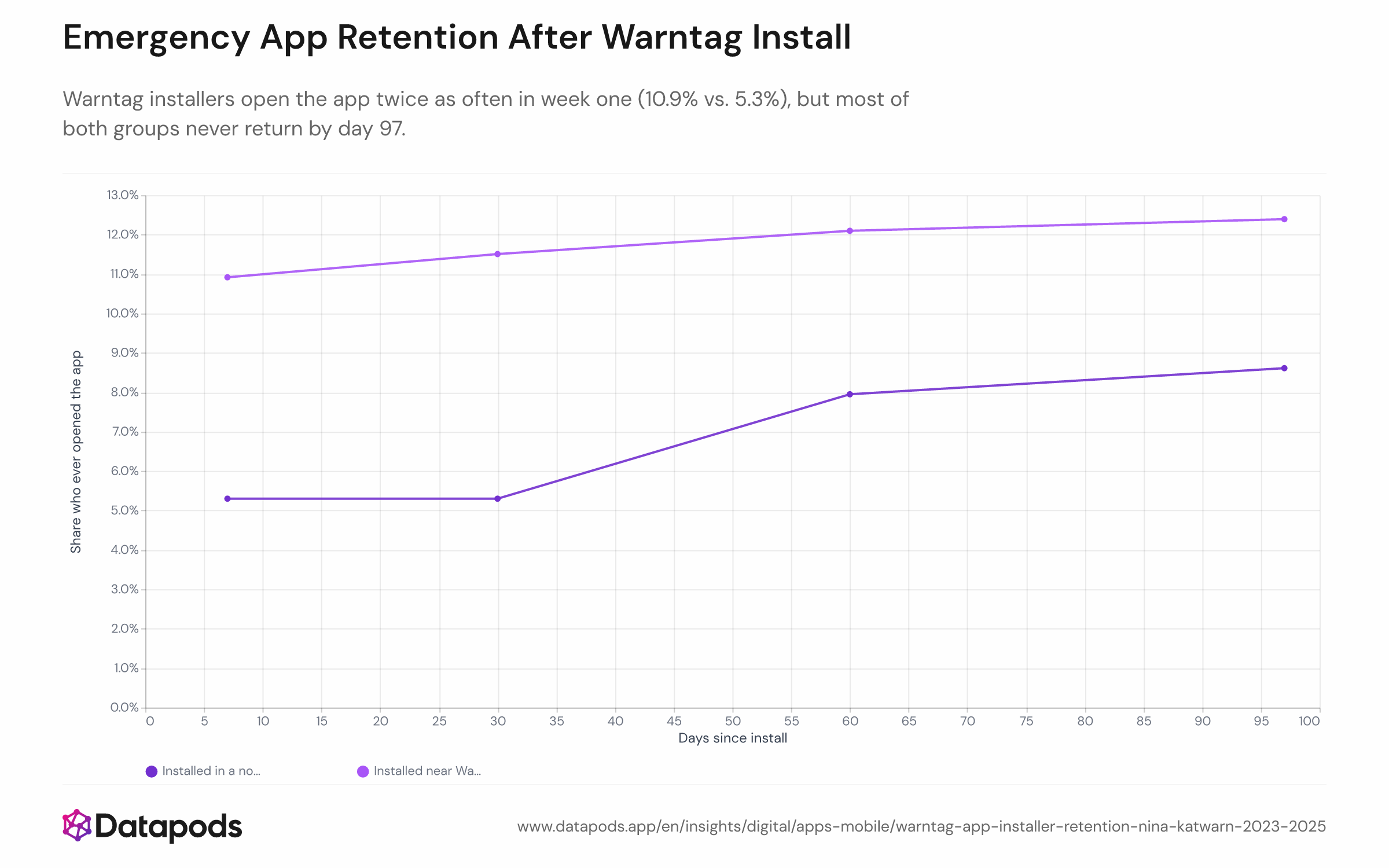
Review 2023–2025 (pooled cohorts): Warntag installers open the app twice as often in week one (10.9% vs. 5.3%), but most of both groups never return by day 97.
Info
- Sample size
- n = 490
- Data date
- 2023–2025 (pooled cohorts)
- Segment
- All segments
- Platform
- Play
- Market
- Germany
Analysis
People who install NINA or KATWARN around the Warntag are meaningfully more engaged in the first week than those who install at other times — 10.9% open the app within seven days versus 5.3% for a matched baseline cohort installing 60–67 days after the event. By day 97, however, the gap narrows to 12.4% versus 8.6%, and the absolute rates reveal that most installers of either type generate no second app-open at all.
Why emergency apps struggle to retain
This pattern is characteristic of utility apps with rare but salient triggers: the download is prompted by a vivid, publicly shared moment (sirens, Cell Broadcast alerts, news coverage), but the app has little reason to be opened on ordinary days. NINA's value proposition — detailed location-specific warnings and, since July 2025, police alerts — is strongest precisely when a real emergency occurs, not in between. The Warntag gives installers a hands-on experience with the alert, which explains the day-1 engagement lift. But without push notifications outside of active warnings, the app effectively goes dormant for most users. The convergence of Warntag and baseline cohorts by day 97 suggests that sustained retention strategies — periodic reminders, seasonal severe-weather tips — could meaningfully extend the initial engagement window for the roughly one-in-ten users who do reopen.
This analysis is based on public segment data. For deeper cuts, use our Enterprise interface.
Methodology
Two installer cohorts were compared across pooled Warntag years 2023–2025: a Warntag cohort (339 users who installed NINA or KATWARN within ±3 days of the event) and a baseline cohort (151 users who installed the same apps 60–67 days after Warntag). For each cohort, the share of users who opened the app at least once within a given number of days post-install was tracked up to day 97 — a window chosen so that all cohorts, including the 2025 Warntag group, have a fully observed follow-up period before the August 2026 data cutoff. The comparison is within-panel and behavioural, not a population-representative statistic.
These insights are based on the Datapods Panel. Our data comes exclusively from users who are compensated for their anonymity. Become part of the panel & earn from your data