
Home & Garden: Interest-to-Purchase Gap
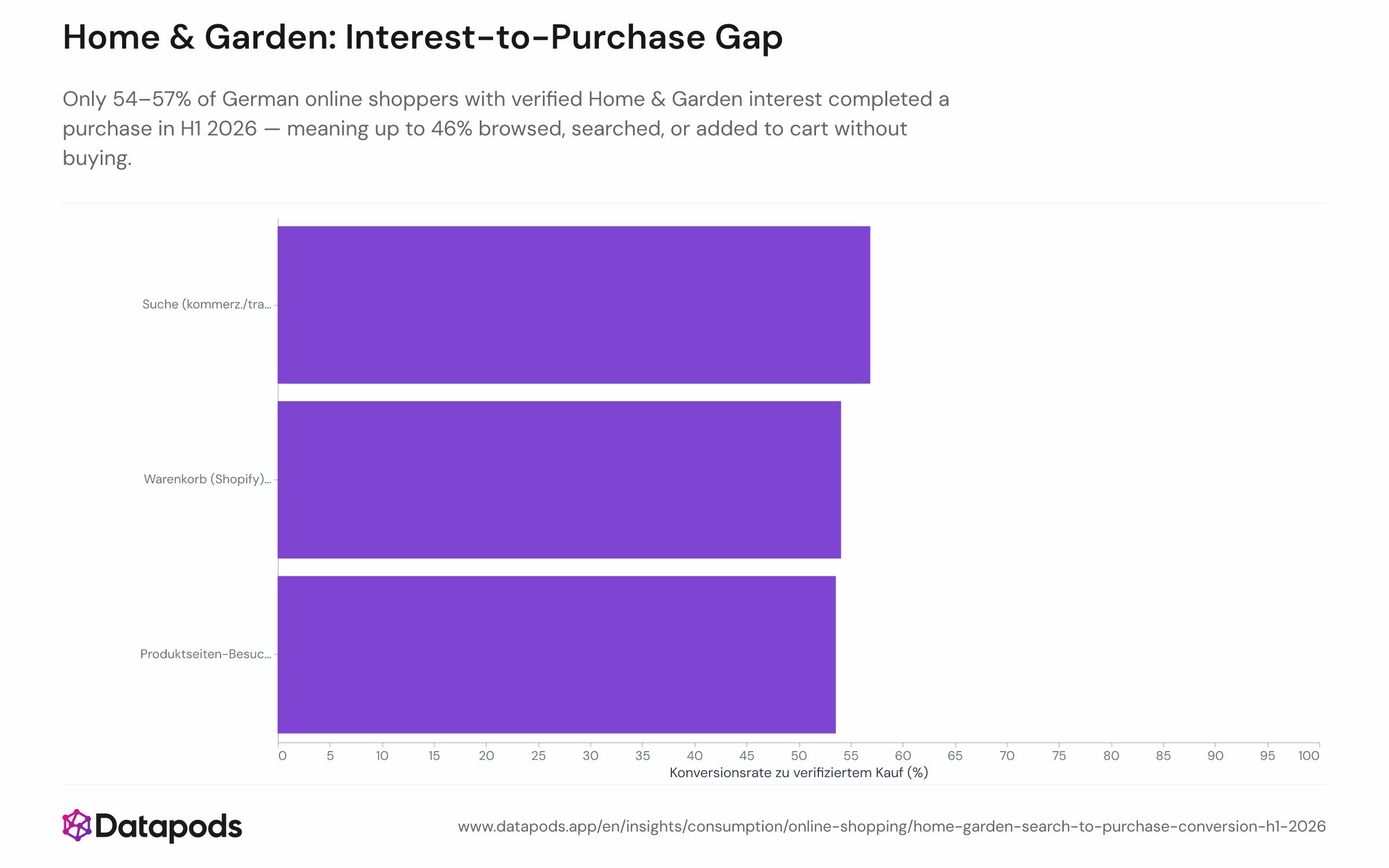
Review H1 2026: Only 54–57% of German online shoppers with verified Home & Garden interest completed a purchase in H1 2026 — meaning up to 46% browsed, searched, or added to cart without buying.
Info
- Sample size
- n = 4,794
- Data date
- H1 2026
- Segment
- All segments
- Platform
- Browsing, Purchases, Search
- Market
- Germany
Analysis
Even fully observable, trackable buying signals — category searches, product-page visits, cart additions — predicted a verified Home & Garden purchase only 54–57% of the time in the first half of 2026. Nearly half of shoppers who demonstrably engaged with the category walked away without buying, a striking reminder that behavioral intent and completed purchase are not the same thing.
Why interest alone doesn't close the deal
Home & Garden is a high-consideration category: products carry meaningful price points, require spatial planning, and are increasingly researched across multiple sessions before purchase. Euromonitor notes that in 2025–2026, consumers remained committed to home improvement but grew more cautious, shifting toward smaller and lower-cost upgrades while deferring larger ticket items. In that climate, a shopper searching for a garden set or browsing power-tool pages is often in a multi-week discovery loop rather than ready to convert. Standard e-commerce conversion rates for Germany sit around 2.1% on a per-session basis — making cross-session funnel collapse the norm, not the exception. The 43–46% non-conversion gap observed here is measured over a full six-month window, meaning it represents the floor of the say-do gap, not a narrow abandoned-cart rate. If even observed behavior leaves this much intent unfulfilled, stated purchase intentions — the currency of traditional concept tests — are likely to diverge from real buying even further.
This analysis is based on public segment data. For deeper cuts, use our Enterprise interface.
Methodology
Rates are measured across German online shoppers tracked in the first half of 2026 (January–June) using co-occurrence within the same six-month window — not a narrow session funnel. Three interest signals are reported independently: category search activity (basis: shoppers with both search and purchase coverage, n ≈ 4,800), product-page browsing (basis: shoppers with both browsing and purchase coverage, n ≈ 4,300), and cart additions (basis: Shopify checkout events only, where cart abandonment is technically detectable, n ≈ 660). For each signal, the rate reflects the share of interested shoppers who also made at least one verified Home & Garden purchase — confirmed via email receipts and marketplace order data — within the same period. Because the measurement window is broad, these rates represent a conservative lower bound on the gap between interest and purchase.
These insights are based on the Datapods Panel. Our data comes exclusively from users who are compensated for their anonymity. Become part of the panel & earn from your data