
Eclipse Search Intensity: 2026 vs. 2025
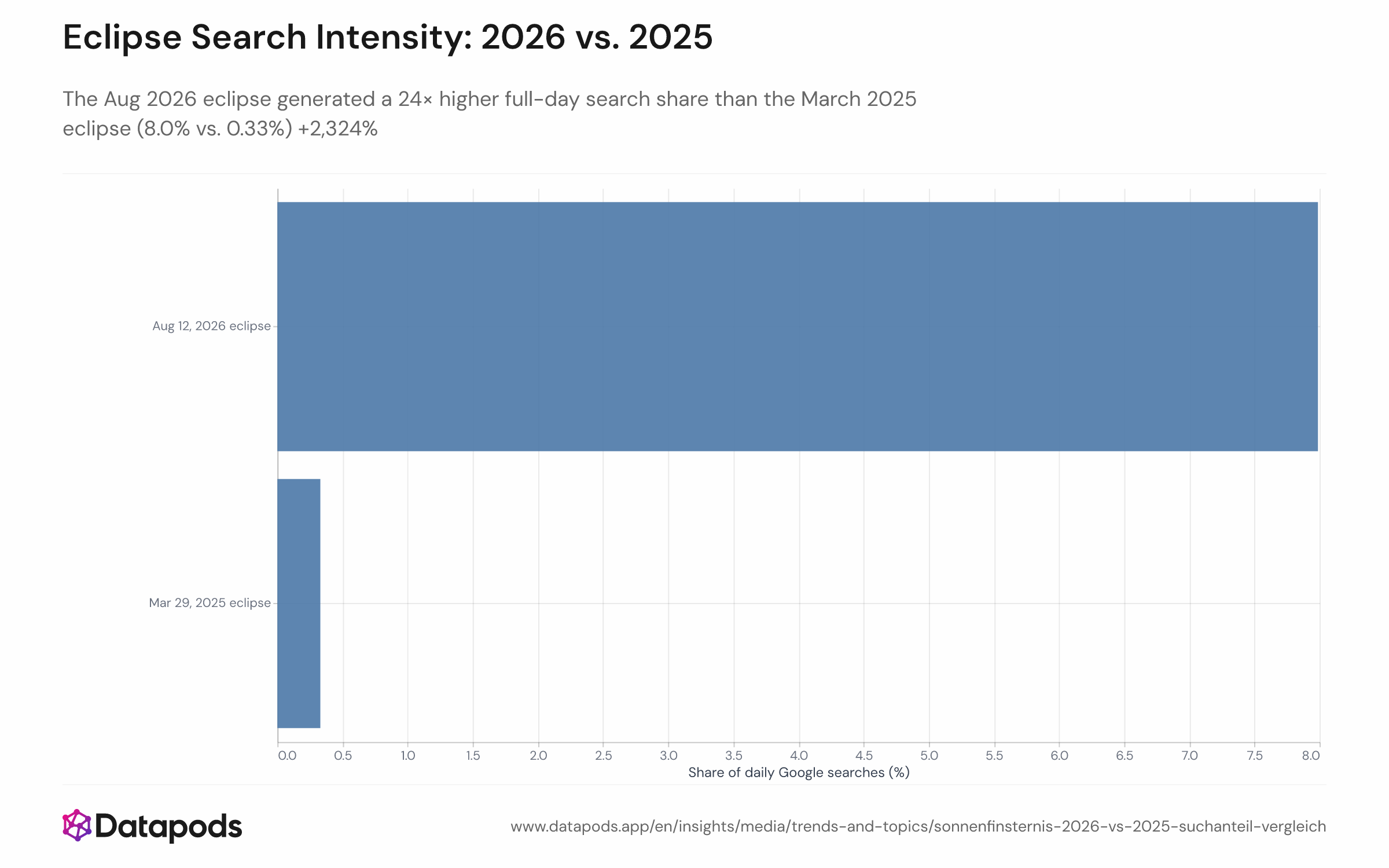
Review Mar 29, 2025 vs. Aug 12, 2026: The Aug 2026 eclipse generated a 24× higher full-day search share than the March 2025 eclipse (8.0% vs. 0.33%) +2,324%
Info
- Sample size
- n = 29,434
- Data date
- Mar 29, 2025 vs. Aug 12, 2026
- Segment
- All segments
- Platform
- Search
- Market
- Germany
Analysis
On August 12, 2026, solar-eclipse terms accounted for 8.0% of all daily Google searches in Germany — 24 times the 0.33% share recorded on March 29, 2025. The gap in peak-hour intensity was even wider: 31.4% versus 1.5%, roughly a 20× difference. Both were partial eclipses visible from Germany, yet the events were categorically different in scale.
Coverage depth and timing explain the gap
The March 2025 eclipse covered only around 15% of the sun over Berlin and occurred at midday on a Saturday — a day with lower baseline search traffic and a less dramatic visual event. The August 2026 eclipse, by contrast, blotted out up to 90% of the sun over southern Germany and fell during a weekday evening, coinciding with the Perseid meteor shower peak and extensive cross-platform media coverage. Broadcasters including ZDF and 3sat ran dedicated evening programs, and the ESA streamed live from Spain, all amplifying search intent. The data suggest that solar-coverage depth — not just astronomical category — is the primary driver of public search interest.
This analysis is based on public segment data. For deeper cuts, use our Enterprise interface.
Methodology
Full-day share of Google search queries containing solar-eclipse terms among German adult online users, comparing August 12, 2026 (eclipse day) with March 29, 2025 (the previous comparable eclipse day). Shares are computed as eclipse-term searches divided by total searches on the same calendar day, making both figures directly comparable despite different total search volumes. Peak-hour figures reflect the single highest-share hour on each respective day.