
Solar Eclipse Engagement by Age Group
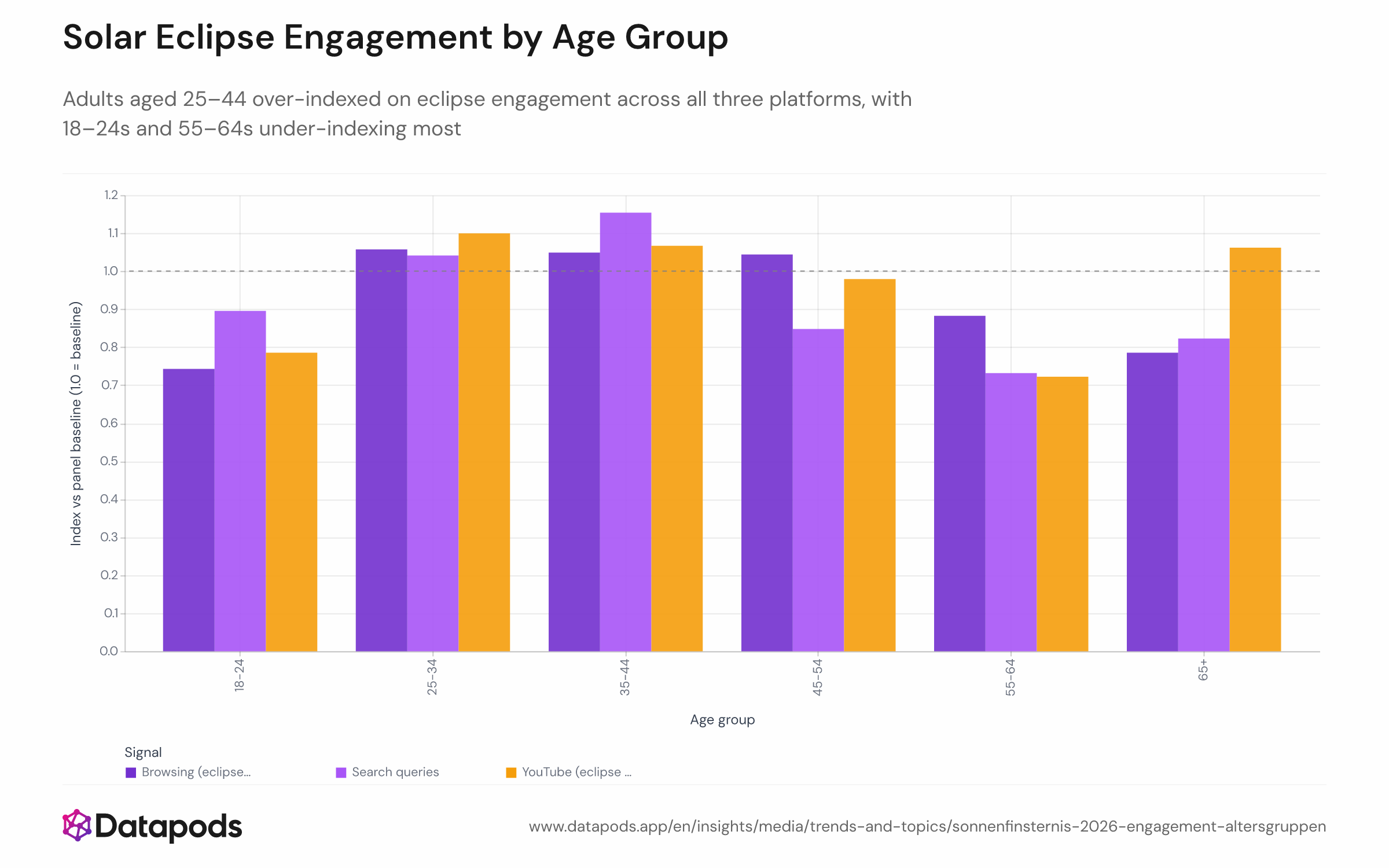
Review Aug 10–13, 2026: Adults aged 25–44 over-indexed on eclipse engagement across all three platforms, with 18–24s and 55–64s under-indexing most
Info
- Sample size
- n = 1,154
- Data date
- Aug 10–13, 2026
- Segment
- 16-24, 25-34, 35-44, 45-54, 55+
- Platform
- Browsing, Search, YouTube
- Market
- Germany
Analysis
The 25–44 age cohort over-indexed on eclipse engagement — with index values of 1.04 to 1.15 across search, browsing, and YouTube — while 18–24-year-olds and 55–64-year-olds under-indexed most (0.72–0.90). The overall skew was modest: no age group was entirely disengaged, pointing to a broadly mainstream audience rather than a niche astronomy community.
An event for family prime time, not just enthusiasts
The eclipse reached its visible maximum in Germany between 20:05 and 20:18 CEST — classic evening prime time — and was reported across ZDF, ARD, and news sites as a family event worth viewing outdoors. The slight youth under-index (18–24) is consistent with that age group's lower engagement with scheduled linear-media events, while the 25–44 over-index aligns with the parenting demographic most likely to share eclipse-viewing with children. The 65+ cohort did not show strong under-indexing on browsing, suggesting older adults engaged through web content even if less so via YouTube.
This analysis is based on public segment data. For deeper cuts, use our Enterprise interface.
Methodology
Age-group engagement index for German adult online users during August 10–13, 2026, covering three signals: eclipse-term search, eclipse-content browsing, and YouTube eclipse-video watch time. The index compares each age group's share of eclipse engagers to that group's share of the overall active user base for the same platform and time window. An index of 1.0 means proportional representation; above 1.0 indicates over-representation. Age groups follow standard census-aligned buckets (18–24, 25–34, 35–44, 45–54, 55–64, 65+).