
Who Buys School Supplies Online in Germany?
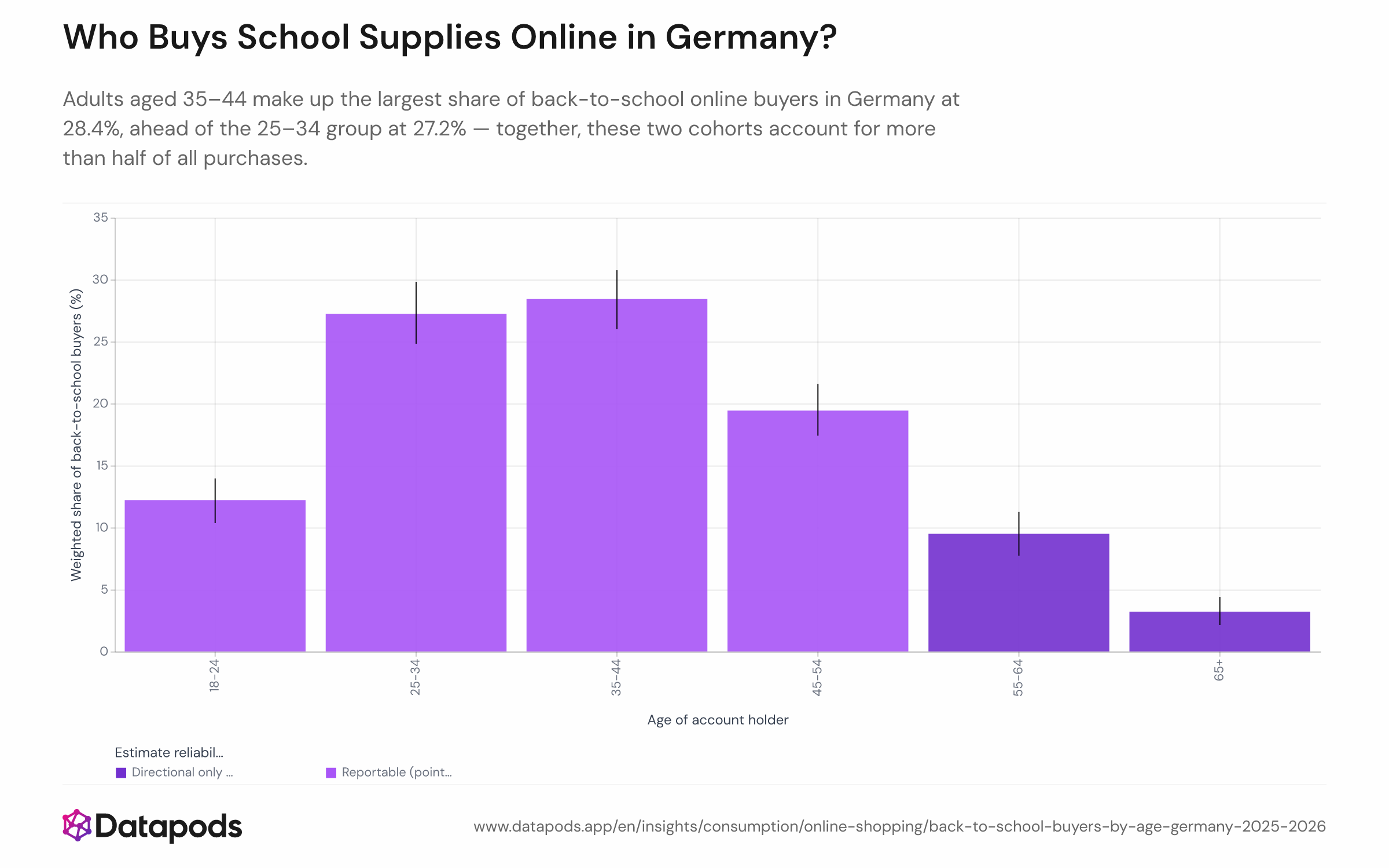
Review Jul 2025 – Aug 2026: Adults aged 35–44 make up the largest share of back-to-school online buyers in Germany at 28.4%, ahead of the 25–34 group at 27.2% — together, these two cohorts account for more than half of all purchases.
Info
- Sample size
- n = 3,029
- Data date
- Jul 2025 – Aug 2026
- Segment
- 16-24, 25-34, 35-44, 45-54, 55+
- Platform
- Purchases
- Market
- Germany
Analysis
The 35–44 age band's lead reflects the life stage of German parents: most families with primary and lower-secondary school children have at least one parent in this bracket. The 25–34 cohort is likely a mix of parents of younger children and students buying their own supplies at university entry.
Parents, not pupils, drive most back-to-school online spending
This age profile aligns with broader German household data: the typical parent of a school-age child in Germany is in their mid-30s to mid-40s. The strong showing from 25–34-year-olds also reflects Germany's growing share of younger families and early-career adults returning to education. The combined 35–44 and 25–34 share of over 55% means that back-to-school campaigns targeting Schulbedarf online kaufen should skew toward established digital channels favoured by Millennial parents — display, social, and paid search — rather than channels with heavier reach among older demographics. The 45–54 group (19.4%) likely includes parents of older secondary students buying equipment like calculators and tablets.
This analysis is based on public segment data. For deeper cuts, use our Enterprise interface.
Methodology
The chart shows the age-band composition of back-to-school online buyers in Germany, weighted to reflect the adult German population. Buyers are defined as those who made at least one purchase in back-to-school categories (stationery, school bags, or laptops and tablets) during July–August 2025 or July 1–August 21, 2026. Age is calculated from birth year against 2026. The four core age bands — 18–24, 25–34, 35–44, and 45–54 — are based on population-weighted estimates with reliable precision; the 55–64 and 65+ bands rest on smaller samples and should be read as indicative rather than precise.
These insights are based on the Datapods Panel. Our data comes exclusively from users who are compensated for their anonymity. Become part of the panel & earn from your data