
Heatwave Browsing Shift by Age Group 2026
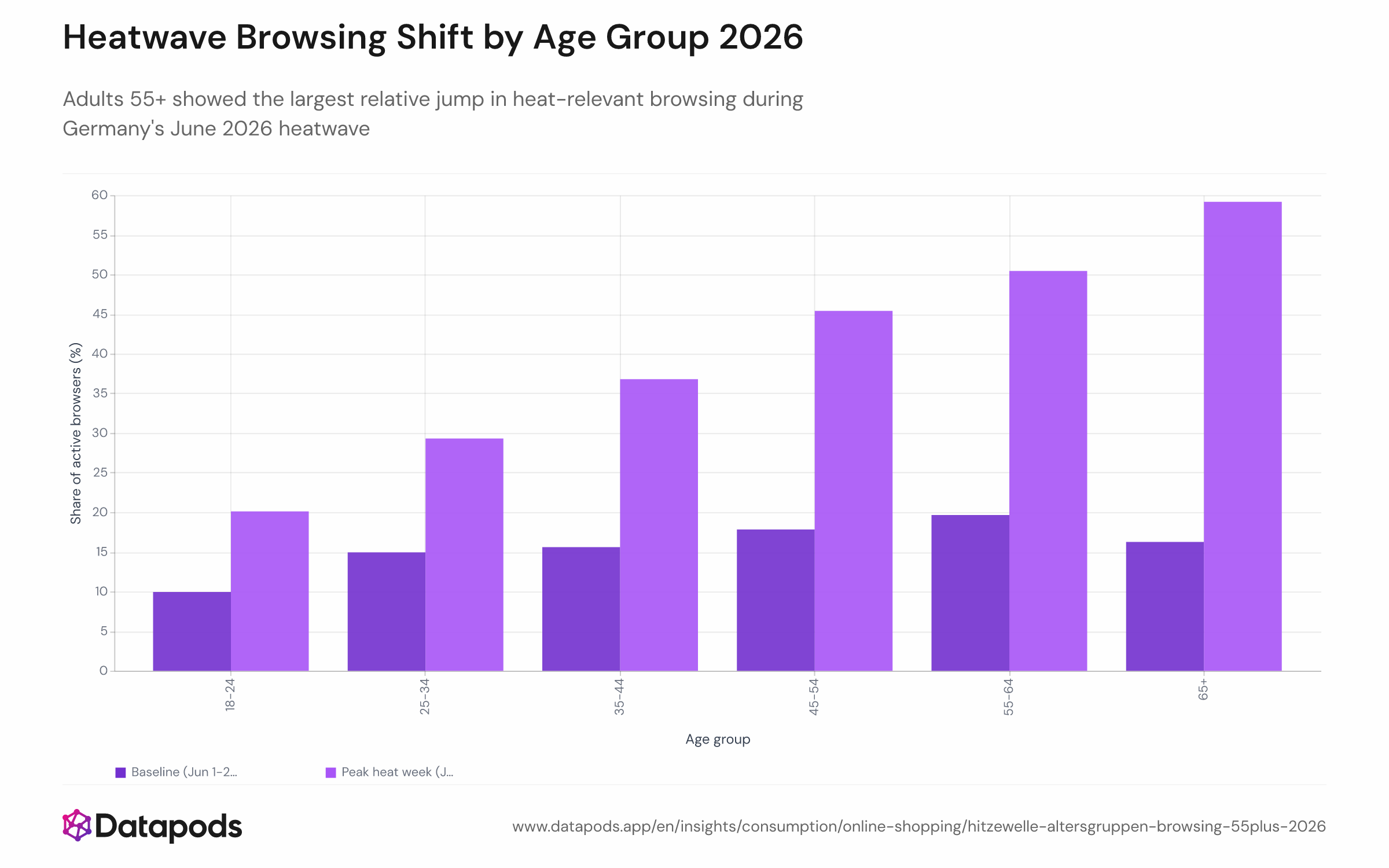
Review June 2026: Adults 55+ showed the largest relative jump in heat-relevant browsing during Germany's June 2026 heatwave
Info
- Sample size
- n = 10,202
- Data date
- June 2026
- Segment
- 16-24, 25-34, 35-44, 45-54, 55+
- Platform
- Browsing
- Market
- Germany
Analysis
Across all age groups, heat-relevant browsing surged in the week of June 22–28, 2026 — but older shoppers aged 55–64 and 65+ drove the steepest proportional increases. Younger cohorts (18–34) showed smaller relative jumps, likely because they were already more active in these categories before the heatwave hit.
Vulnerable Groups Mobilized Online First
Public health authorities including the DWD explicitly flagged older adults as the most vulnerable group during the June 2026 heatwave, urging protective action. Facing extreme temperatures above 40°C and with limited access to air-conditioned spaces, many older Germans appear to have turned to online channels as a primary way to source cooling solutions. This aligns with a broader European pattern: with only around 3% of German homes air-conditioned, first-time cooling-appliance purchases during the heatwave were concentrated among households with no prior need — disproportionately older, established residents rather than younger, more mobile renters. The population-wide impact is quantified in the German adults browsing and buying chart.
This analysis is based on public segment data. For deeper cuts, use our Enterprise interface.
Methodology
Within-panel share of active German online shoppers per age group who viewed heat-relevant product pages (cooling appliances, sun care, cold beverages) during the June 1–21 baseline and the June 22–28 peak heatwave week in 2026. Shares are calculated within each age band separately and presented as a before/after comparison on the same population. Age is derived from year of birth as reported by shoppers. Results are presented at the panel level; population-level weighting was not applied at the per-age-band level due to insufficient sub-group sample sizes.