
BNPL Adoption by Age Group in Germany
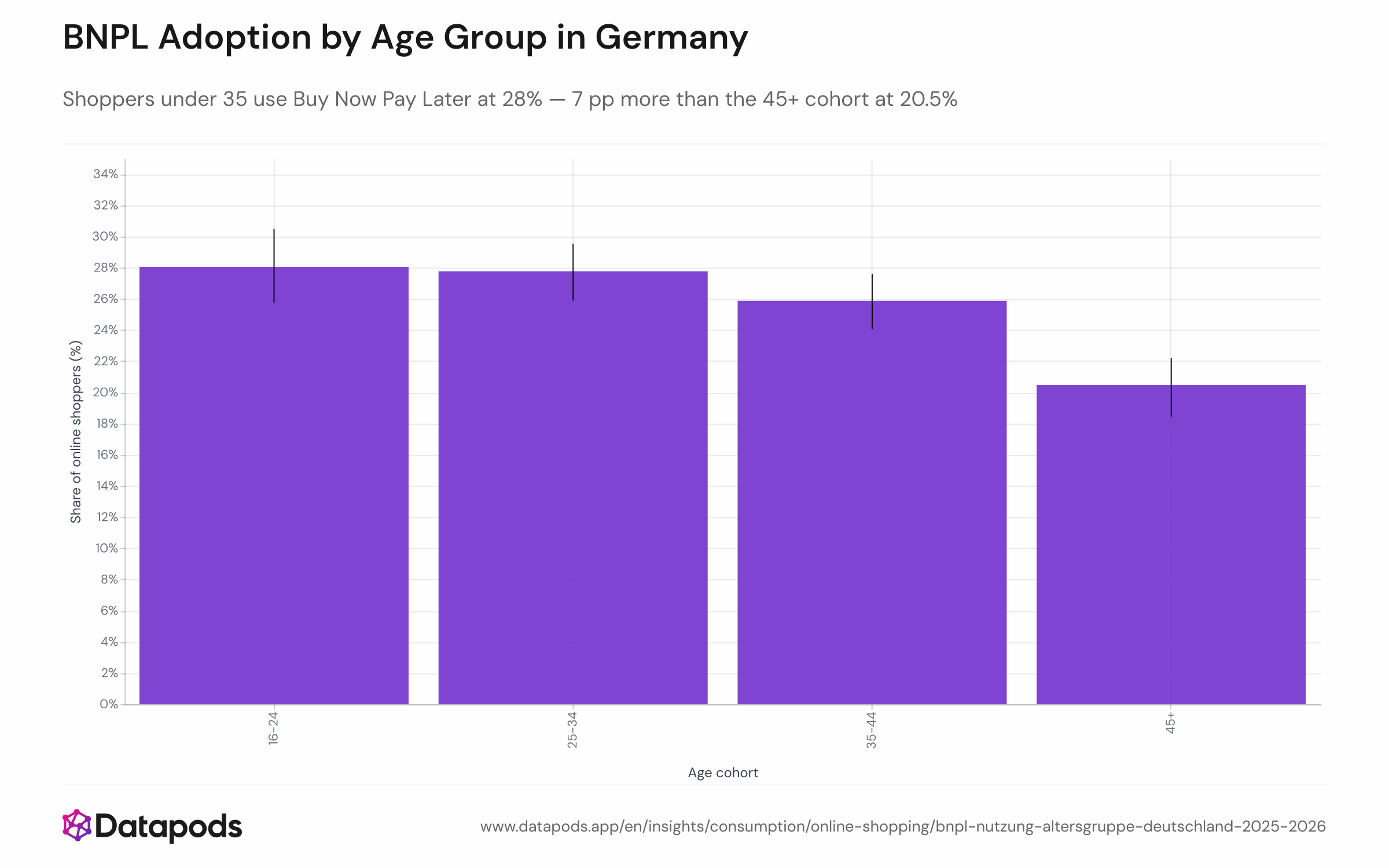
Review Jan 2025 – Jul 2026: Shoppers under 35 use Buy Now Pay Later at 28% — 7 pp more than the 45+ cohort at 20.5%
Info
- Sample size
- n = 16,671
- Data date
- Jan 2025 – Jul 2026
- Segment
- 16-24, 25-34, 35-44, 45-54, 55+
- Platform
- Email, Purchases
- Market
- Germany
Analysis
BNPL adoption among German online shoppers is highest in the 16–34 age band at 28%, compared with 20.5% among shoppers aged 45 and over — a 7.5-percentage-point gap that mirrors patterns seen across other European BNPL markets where younger consumers are the primary driver of installment-payment growth.
Younger shoppers, higher fashion spend, and the BNPL habit loop
The age skew is partly structural: younger German consumers over-index on fashion, the product category with the highest BNPL rate in German e-commerce, and are also more likely to use mobile checkout flows where Klarna and Riverty are prominently positioned. At the same time, the data shows that BNPL in Germany is far from a niche among older shoppers — a 20.5% rate in the 45+ cohort indicates broad cross-generational acceptance of flexible deferred payment, rooted in Germany's long Rechnungskauf tradition. With the CCD II consumer credit directive applying from 20 November 2026 — bringing mandatory affordability checks to all BNPL providers — the friction introduced at checkout may cool adoption rates disproportionately among younger, lower-income users who were previously approved with minimal screening. Providers and retailers are monitoring this closely as the November deadline approaches.
This analysis is based on public segment data. For deeper cuts, use our Enterprise interface.
Methodology
The share shown for each age cohort is the proportion of German online shoppers in that age band — defined by birth year as of 2026 — who recorded at least one Buy Now Pay Later payment signal between January 2025 and July 2026. The four bands are 16–24, 25–34, 35–44, and 45 and over. Results are weighted to reflect the German adult online-shopping population within each cohort. Shoppers with no recorded birth year are excluded from this breakdown only.