
BYD Search Interest by Age Group in Germany — 2025–2026
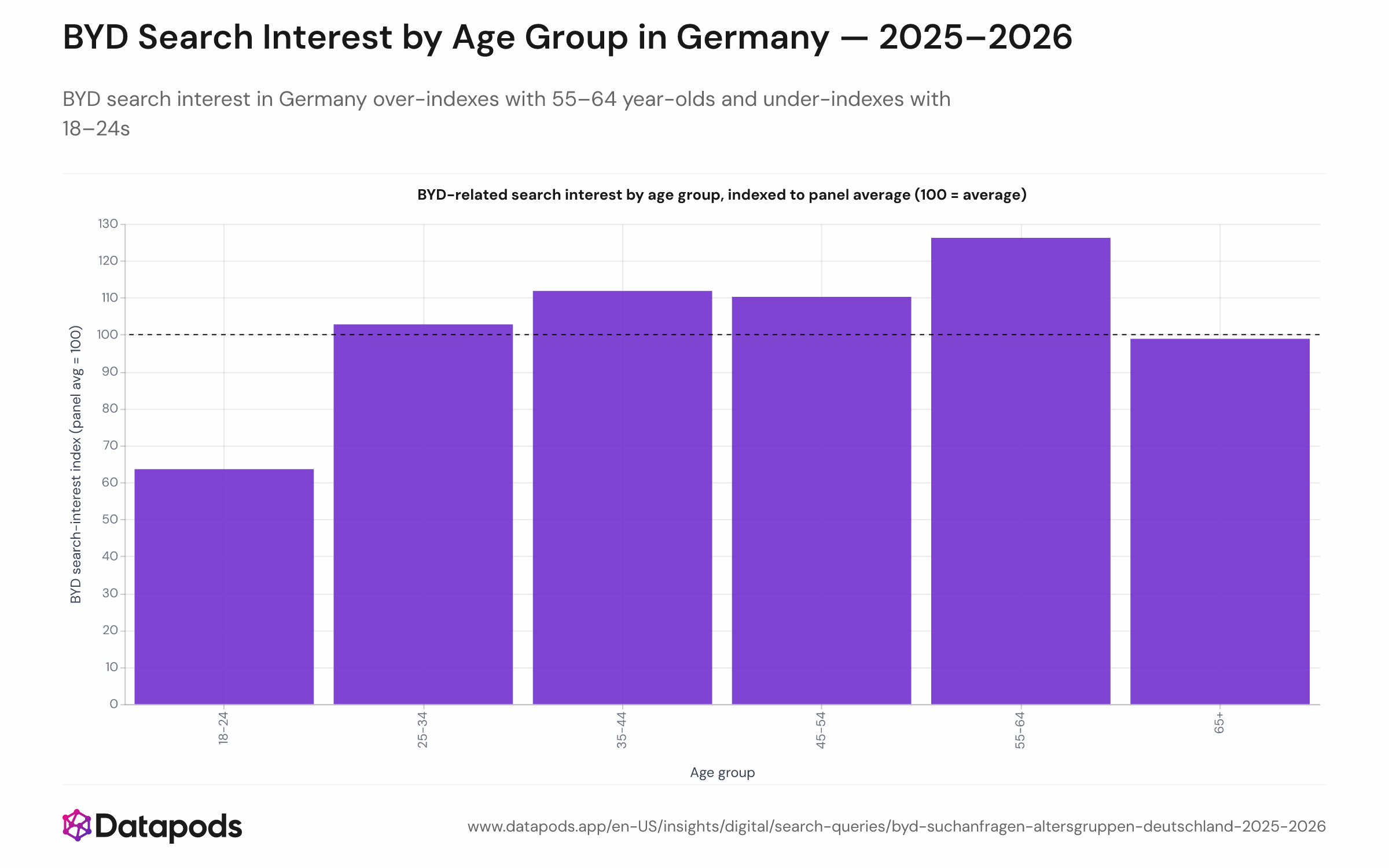
Review Jan 2025 – Jun 2026: BYD search interest in Germany over-indexes with 55–64 year-olds and under-indexes with 18–24s
Info
- Sample size
- n = 27,064
- Data date
- Jan 2025 – Jun 2026
- Segment
- 16-24, 25-34, 35-44, 45-54, 55+
- Platform
- Search
- Market
- Germany
Analysis
Across the full 18-month window, the 55–64 age group shows the strongest relative interest in BYD among all German age cohorts — well above average — while 18–24 year-olds are the least likely to search for the brand relative to their overall search activity.
Why the practical buyer beats the tech-first browser
This age skew has a compelling parallel in real purchase data. BYD's fastest-selling models in Germany — the Atto 3 SUV, the Seal U DM-i plug-in hybrid, and the Seal 6 Touring — are practical, range-oriented vehicles positioned at price points accessible to consumers with established incomes. German private-buyer registrations rose sharply in 2025 and early 2026, with nearly 40% of BYD's March 2026 sales going to private consumers rather than fleets — a sign that the buying demographic skews toward settled, purchase-ready adults rather than the aspirational youth segment that drove early Tesla adoption. Younger Germans are more likely to be renting, leasing, or deferring major purchase decisions; the 55–64 cohort, by contrast, sits at peak car-buying age and disposable income. BYD's value proposition — generous specification at a competitive price point — aligns naturally with that group's purchasing calculus.
This analysis is based on public segment data. For deeper cuts, use our Enterprise interface.
Methodology
The index compares each age group's share of all BYD-related Google search queries in Germany against that group's share of all search queries overall, over the period January 2025 to June 2026. An index of 100 means the group searches for BYD exactly as often as their general activity would predict; values above 100 signal above-average BYD interest for that group. Age is derived from users' birth year relative to 2026.