
AI-Referenced Product Search Behaviour by Age Group in Germany — 2025 to Q1 2026
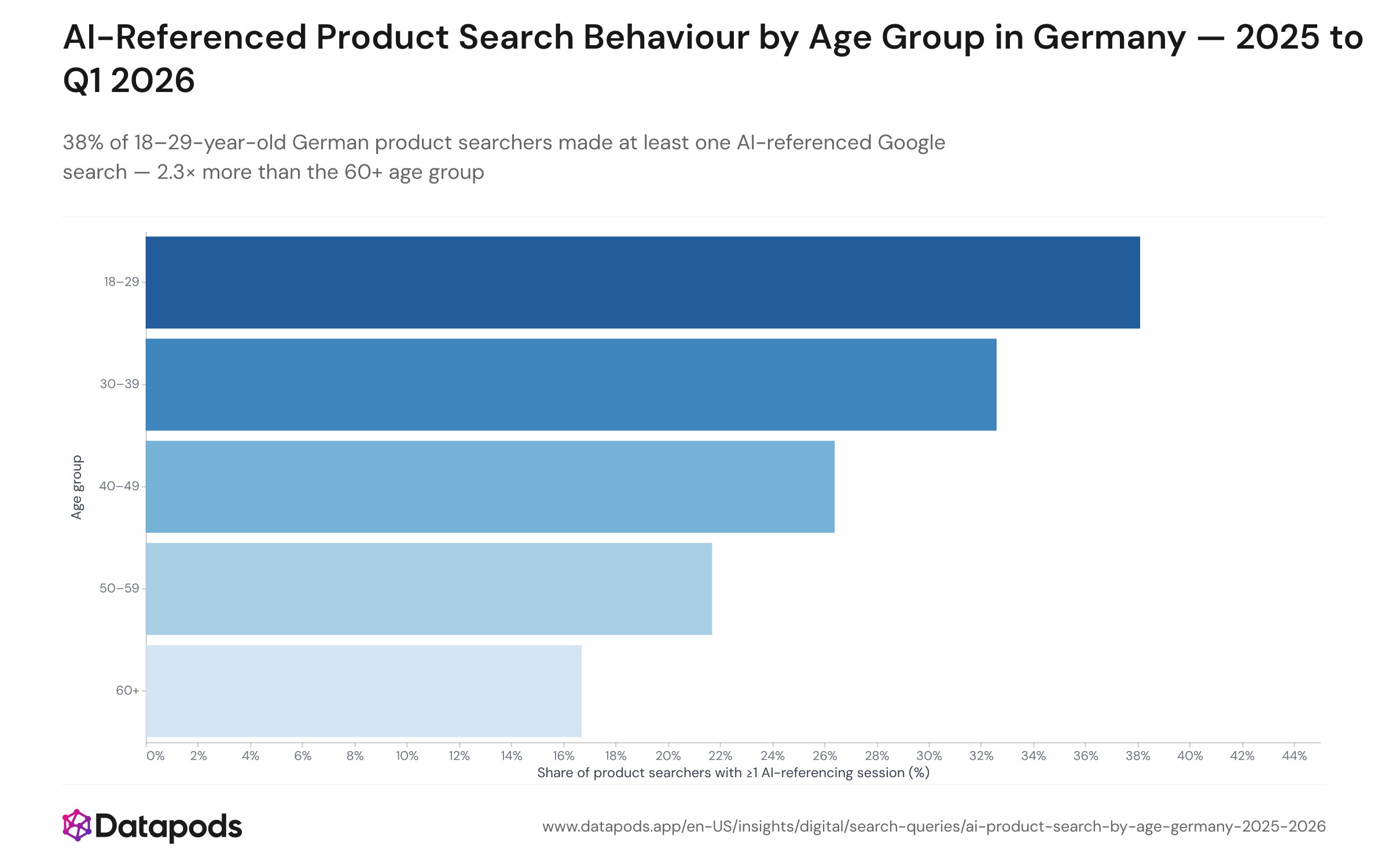
Review 2025 – Q1 2026: 38% of 18–29-year-old German product searchers made at least one AI-referenced Google search — 2.3× more than the 60+ age group
Info
- Sample size
- n = 43,031
- Data date
- 2025 – Q1 2026
- Segment
- 16-24, 25-34, 35-44, 45-54, 55+
- Platform
- Search
- Market
- Germany
Analysis
38% of German product searchers aged 18–29 generated at least one AI-referencing Google search session over the 15-month observation window, compared with just 17% of those aged 60 and older — a 2.3× gradient that signals how unevenly the AI-driven shift in shopping research is distributed across generations.
Younger buyers are normalising AI-assisted Kaufentscheidungen
This age split is consistent with broader platform demographics: globally, users aged 18–34 account for over 52% of Gemini's audience and ChatGPT disproportionately attracts younger, tech-early-adopter profiles. In Germany, where 81% of consumers advocate for clear labelling of AI-generated content, younger shoppers appear less concerned about AI provenance and more willing to integrate chatbot-style tools into their everyday product research. The HDE Online Monitor 2026 confirms AI is gaining structural relevance in German e-commerce, reporting that 35% of the German population now use AI for product research — a figure anchored heavily by younger cohorts. For marketers, the implication is clear: AI product recommendations are already a primary discovery channel for under-30s, and that behaviour will age upward as digital natives move through life stages.
This analysis is based on public segment data. For deeper cuts, use our Enterprise interface.
Methodology
For each age group, the metric represents the share of German product-intent searchers — active on Google between January 2025 and March 2026 — who produced at least one search session containing an explicit AI tool reference (ChatGPT, Gemini AI, Perplexity, or Microsoft Copilot) over the full observation period. Age was determined from user birth-year records. The denominator in each cohort is all users in that age group with at least one product-intent search session in the window.