
Supplement Buyer Penetration by Age Group and Gender Among Online Shoppers in Germany — 2025 to Q1 2026
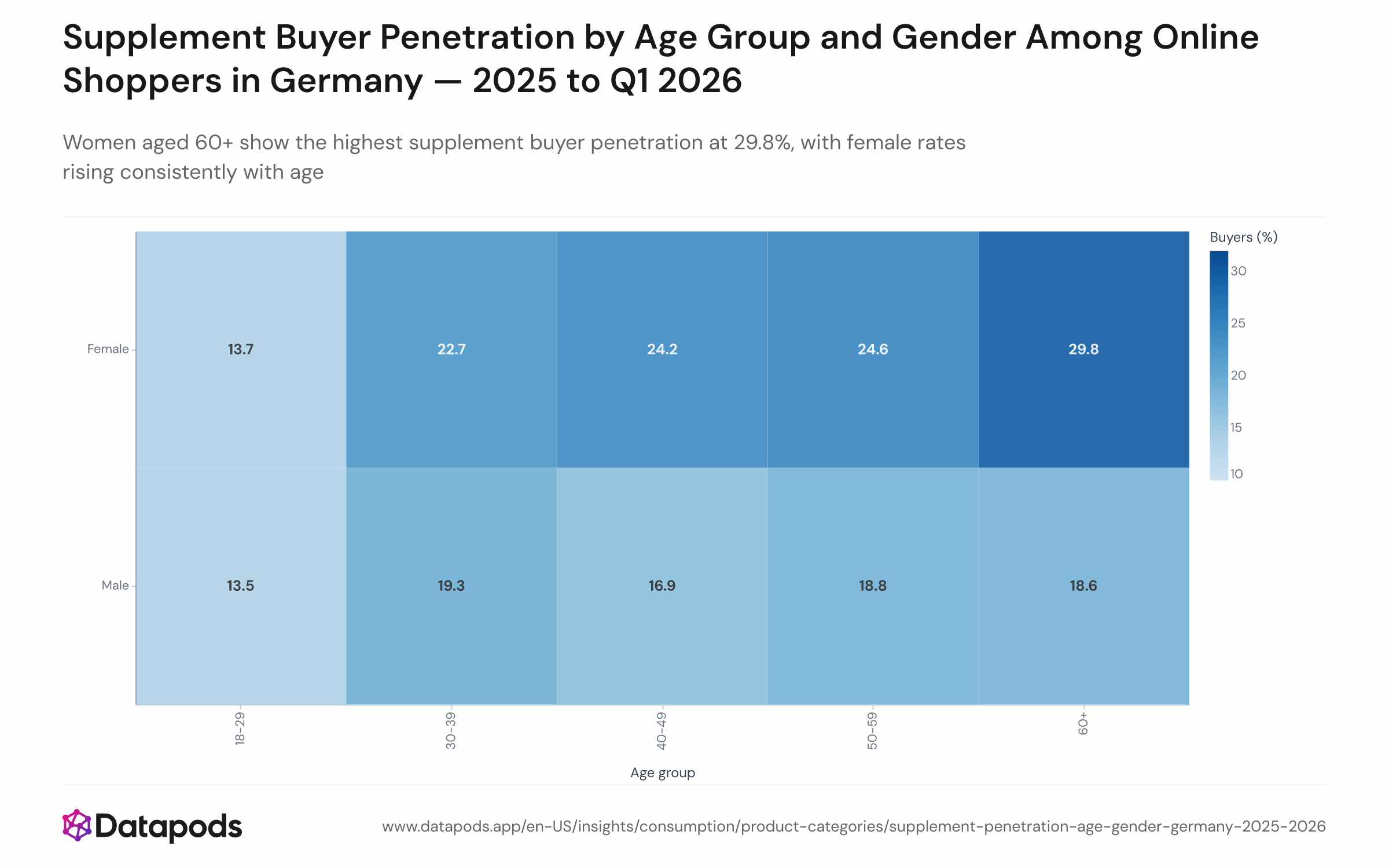
Review 2025 – Q1 2026: Women aged 60+ show the highest supplement buyer penetration at 29.8%, with female rates rising consistently with age
Info
- Sample size
- n = 2,259
- Data date
- 2025 – Q1 2026
- Segment
- male, female · 16-24, 25-34, 35-44, 45-54, 55+
- Platform
- Email, Purchases
- Market
- Germany
Analysis
Among active German online shoppers, female buyers aged 60 and over have the highest supplement penetration at 29.8% — nearly three in ten women in this age group added at least one supplement to their online basket over the study period. Female penetration climbs monotonically across every age band, while male penetration peaks at ages 30–39 (19.3%) and then plateaus.
Ageing population meets preventive health demand
The age-driven gradient for women aligns with macro trends in the German supplement market: industry analysts flag older women as the fastest-growing buyer segment, driven by joint and bone health needs, menopause-related supplement use, and growing awareness of Vitamin D and Magnesium deficiency risks. Mintel data shows that although 28% of over-65s have not yet tried supplements, older consumers are expected to play an increasingly larger role as the population ages. The male peak at 30–39 reflects the sports nutrition and protein segment, where fitness-motivated younger men are the core buyer. For brands, the female 60+ segment represents the highest-reach age group online and a clear growth frontier for targeted Vitamin D, Magnesium, and collagen products in Germany 2025 and beyond.
This analysis is based on public segment data. For deeper cuts, use our Enterprise interface.
Methodology
Supplement buyer penetration is calculated as the share of active online shoppers within each age-and-gender group who placed at least one supplement order — across Amazon.de and specialist retailers — during the period January 2025 to Q1 2026. The denominator is all active online buyers in each demographic cell. Results are presented separately for male and female buyers across age bands (18–29, 30–39, 40–49, 50–59, 60+). Cells with fewer than five buyers are excluded; all displayed cells meet a minimum buyer count.