
Health Supplement Purchase Rate Among Online Shoppers in Germany — Q1 2025 to Q1 2026
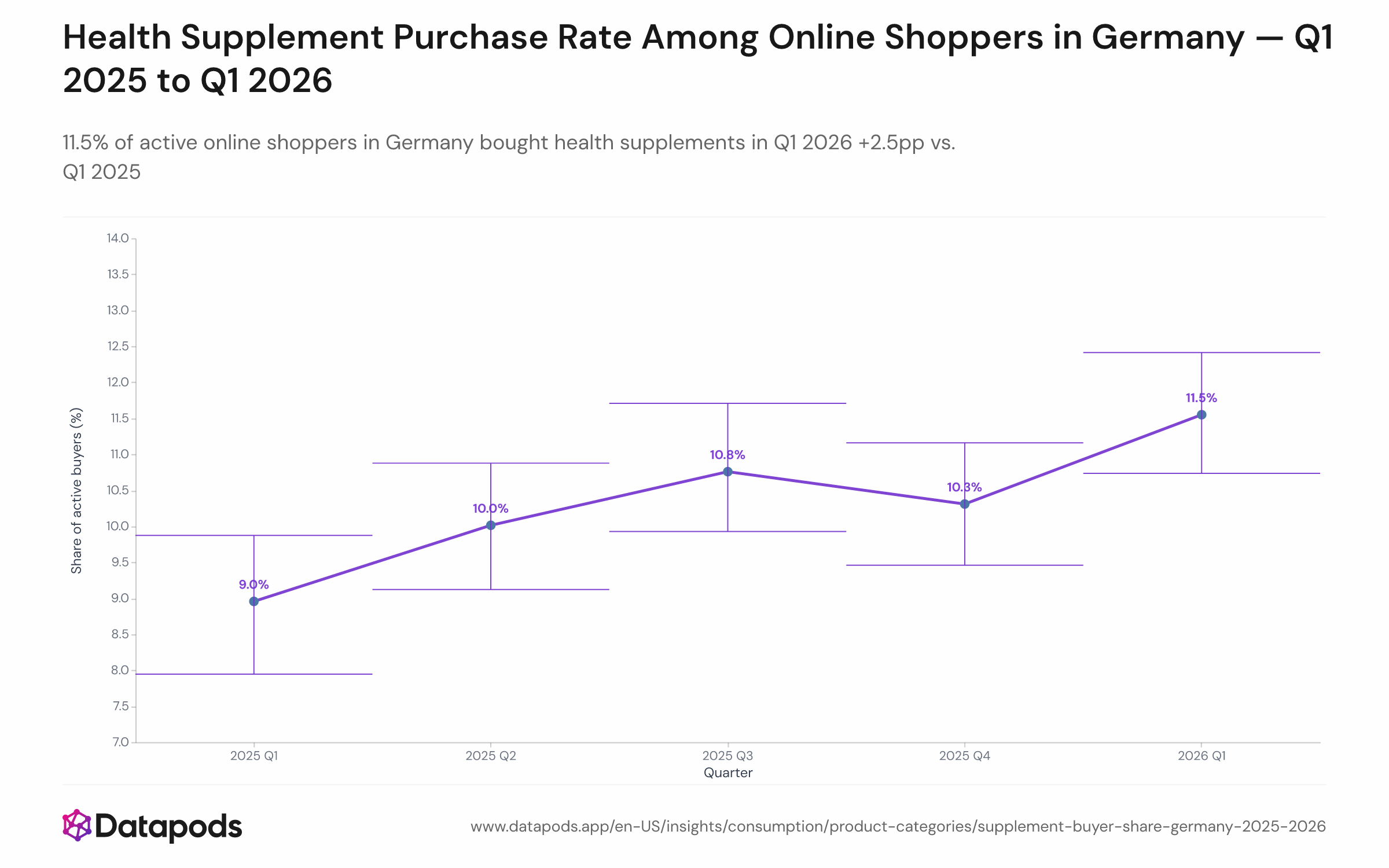
Review Q1 2025 – Q1 2026: 11.5% of active online shoppers in Germany bought health supplements in Q1 2026 +2.5pp vs. Q1 2025
Info
- Sample size
- n = 1,165
- Data date
- Q1 2025 – Q1 2026
- Segment
- All segments
- Platform
- Email, Purchases
- Market
- Germany
Analysis
Health supplement purchase rates among German online shoppers climbed from 9.0% in Q1 2025 to 11.5% in Q1 2026 — a five-quarter upward trend that mirrors the broader acceleration in German e-commerce health spending.
Germany's supplement boom reaches online checkout
Germany is one of Europe's largest supplement markets, and the online channel is growing fastest: over 70% of German supplement consumers now buy such products via the internet, with Amazon.de leading the way. The German supplement market posted roughly 10% year-on-year revenue growth in early 2025, driven by heightened health consciousness, an ageing population, and a widening array of products covering everything from Vitamin D and Magnesium to protein and collagen. The steady quarterly rise in buyer share — unbroken across all five measured periods — suggests this is structural demand growth rather than seasonal noise. Brands targeting German wellness shoppers online have a growing but still-modest-sized addressable base, with room to convert the majority of online shoppers who have yet to add a supplement to their basket. See how spend levels vary by subcategory in Supplement Median Order Value by Category and Channel.
This analysis is based on public segment data. For deeper cuts, use our Enterprise interface.
Methodology
The buyer share tracks the proportion of German adults who made at least one online purchase of a supplement — covering vitamins, minerals, protein, collagen, or probiotics — in a given quarter. Purchases are measured across Amazon.de orders and email receipts from German online retailers. Results are representative of the German adult online shopping population and are tracked quarterly from Q1 2025 through Q1 2026.