
Amazon.de Category Order Index — 55+ vs. 25–44 Shoppers in Germany, 2024–2025
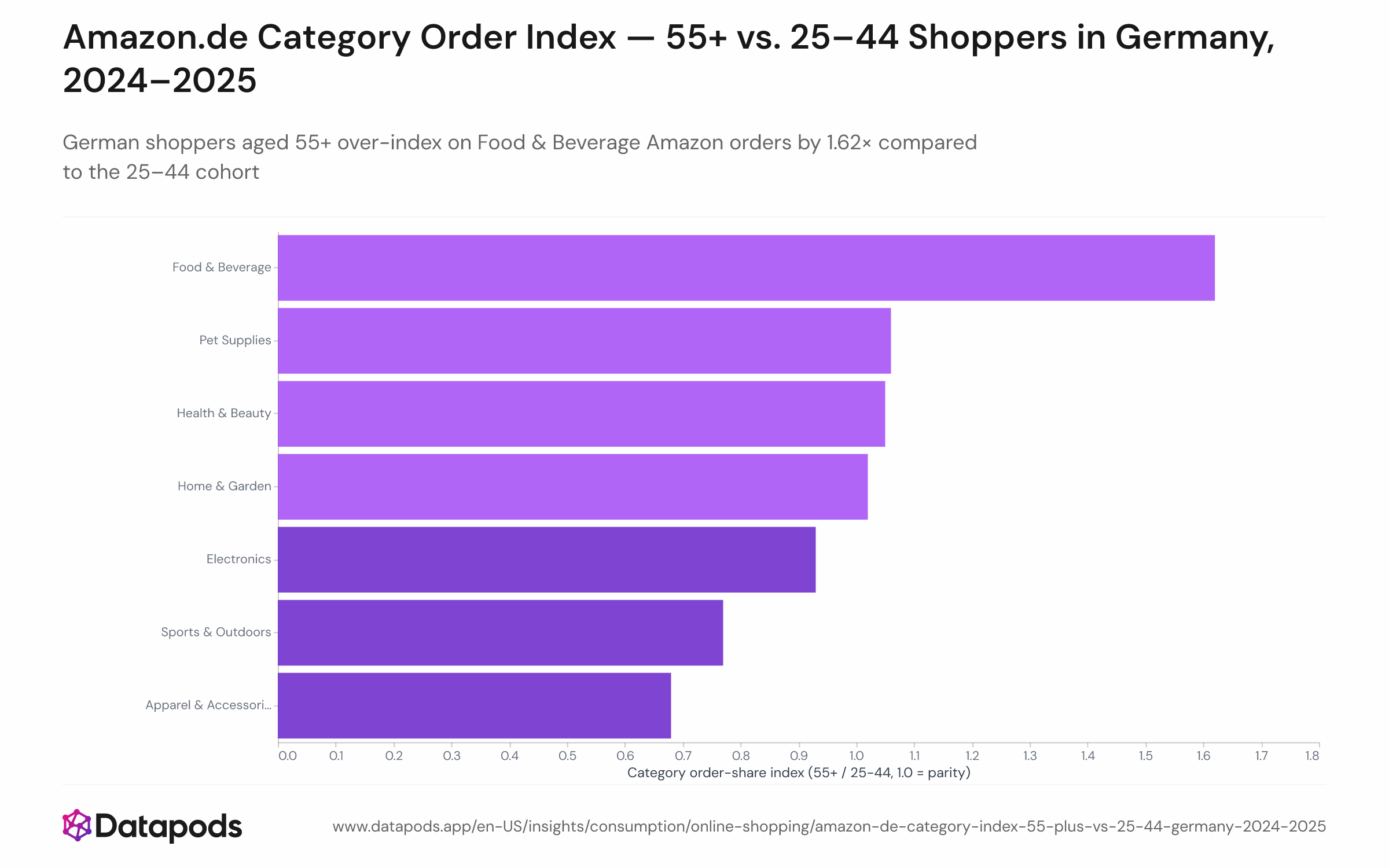
Review 2024–2025: German shoppers aged 55+ over-index on Food & Beverage Amazon orders by 1.62× compared to the 25–44 cohort
Info
- Sample size
- n = 4,562
- Data date
- 2024–2025
- Segment
- All segments
- Platform
- Purchases
- Market
- Germany
Analysis
Among all product categories on Amazon.de, Food & Beverage shows the strongest age skew: shoppers aged 55 and over place food orders at 1.62 times the rate of the 25–44 cohort, while Apparel & Accessories sits at the other extreme with a 0.68× under-index.
Amazon's grocery push meets Germany's oldest-growing shopper cohort
The 55+ cohort's tilt toward food mirrors a well-documented behavioral pattern: research on online grocery adoption among Germans aged 55–65 identifies convenience and crowd avoidance as the primary drivers of online food purchases for this age group. Amazon has been actively expanding its grocery footprint in Germany — its November 2024 partnership with Knuspr brought a 15,000-item assortment to Prime members across Berlin, Munich, and the Rhine-Main corridor. That expansion, combined with Germany's food e-commerce sector growing at 10.4% year-on-year, creates structural conditions that favor older, convenience-oriented buyers. The under-indexing in Apparel reflects a broader trend: fashion discovery in Germany skews toward younger, mobile-native, social-commerce audiences — a pattern consistent with the device preferences shown in How 55+ shoppers browse Amazon.de on desktop vs. mobile.
This analysis is based on public segment data. For deeper cuts, use our Enterprise interface.
Methodology
Category order-share index is calculated from completed, revenue-positive Amazon.de orders placed by German shoppers between 2024 and 2025, matched to product taxonomy. Each category's share of total orders is computed separately for shoppers aged 55+ and for those aged 25–44. The index value is the ratio of the 55+ category share to the 25–44 category share: a value of 1.0 indicates parity, above 1.0 indicates the older cohort over-indexes, and below 1.0 indicates under-indexing.