
Amazon Prime Day 2025 vs. 2024 Order Volume Shape in Germany — Four-Day vs. Two-Day Format
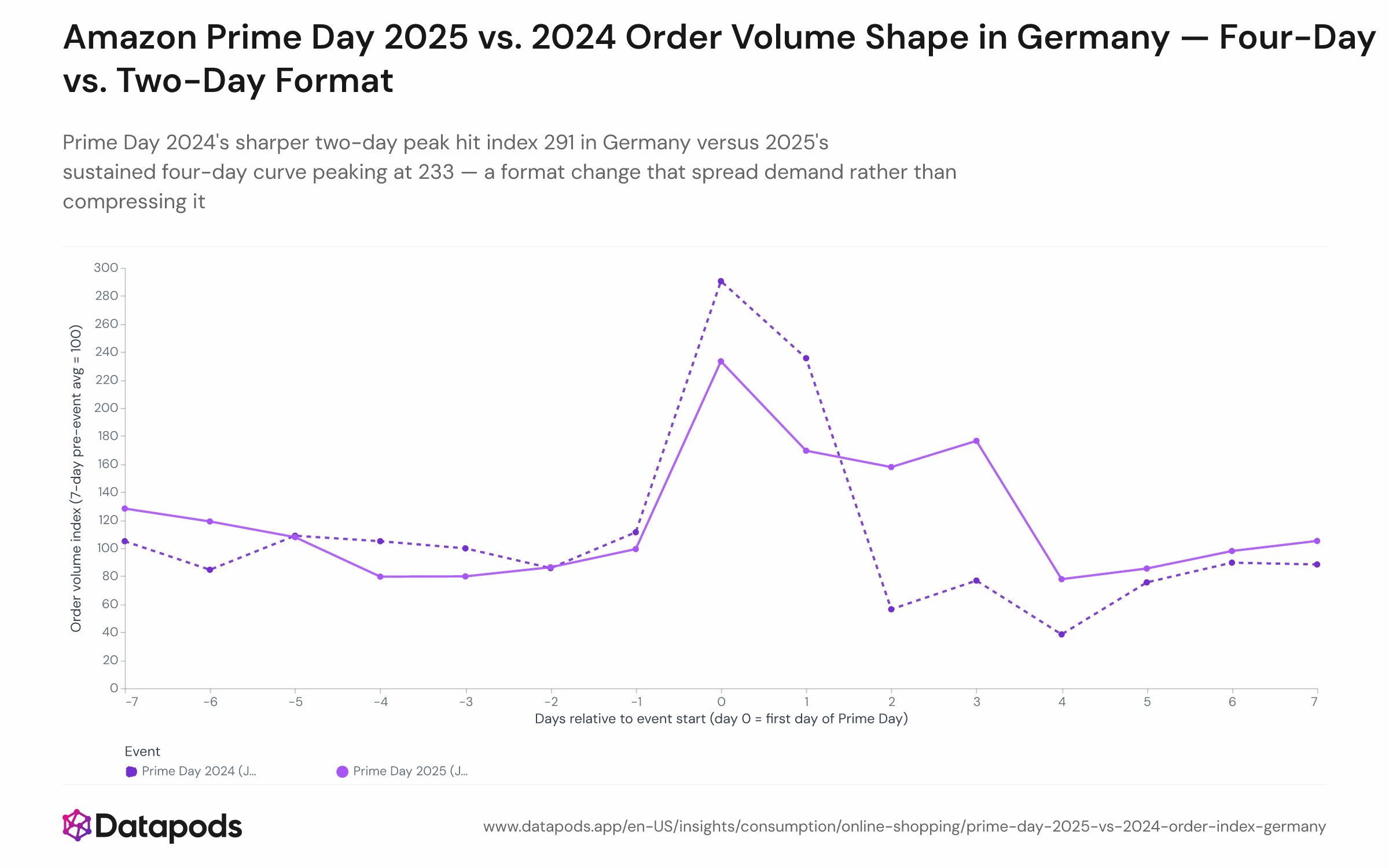
Review July 2024 vs. July 2025: Prime Day 2024's sharper two-day peak hit index 291 in Germany versus 2025's sustained four-day curve peaking at 233 — a format change that spread demand rather than compressing it
Info
- Sample size
- n = 6,542
- Data date
- July 2024 vs. July 2025
- Segment
- All segments
- Platform
- Purchases
- Market
- Germany
Analysis
The year-over-year comparison of Amazon Prime Day order volumes in Germany reveals how much format determines shape: Prime Day 2024 (two days, July 16–17) produced a dramatic index spike to 291 on day one, followed by a steep drop to below-baseline (index 56) by the second post-event day. Prime Day 2025 (four days, July 8–11) spread the same buying impulse across a broader curve — peak index 233, four-day average 184 — with demand falling below baseline only after the event closed.
What the format shift means for Prime Day 2026 Bestellverhalten in Deutschland
Amazon confirmed it is retaining the four-day format for Prime Day 2026 (June 23–26, Germany), citing strong engagement across all four days in 2025. The 2025 data from Germany supports that decision: sustained elevation without the sharp single-day exhaustion seen in 2024. The June 2026 timing introduces a new variable — the FIFA World Cup 2026 runs June 11–July 19, a period Amazon executives explicitly cited when choosing the earlier date. Whether World Cup viewing crowds out or amplifies electronics and sports gear purchasing is a key open question the 2025 benchmarks can help frame.
This analysis is based on public segment data. For deeper cuts, use our Enterprise interface.
Methodology
Daily Amazon.de order volumes for German shoppers were indexed against each year's respective seven-day pre-event average (index = 100) for both Prime Day 2024 (July 16–17) and Prime Day 2025 (July 8–11). Days are aligned to a common event-relative axis: day 0 represents the first event day in each year. Completed orders with a positive transaction value are counted once per unique order. The two years are presented on a normalized index scale to allow shape comparison independent of absolute panel size differences between years.