Market Segmentation: Criteria, Models and Examples
What is market segmentation? Criteria, models and an example, plus how to build segments from real behavior instead of assumptions.
3 min read
Two customers of the same age, city and income often shop completely differently. That is why treating a market as a single mass does not work. Market segmentation splits it into groups you can address deliberately.
What is market segmentation?
Market segmentation is the division of a total market into homogeneous sub-markets, called segments, whose members share similar needs, characteristics or behaviors. The goal is to tailor the offer, price and communication precisely to a segment, rather than treating the whole market the same.
A viable market segment meets four conditions: it is measurable, sufficiently large, reachable and internally similar, while clearly differing from other segments. If any of these is missing, the segment cannot be worked with in practice.
Segmentation criteria
Segments form along criteria. In practice you usually combine several dimensions, because a single trait rarely yields a sharply defined group.
| Criterion | Examples |
|---|---|
| Geographic | Country, region, urban vs. rural, climate zone |
| Demographic | Age, gender, income, occupation, household size |
| Psychographic | Values, lifestyle, attitudes, motives |
| Behavioral | Purchase behavior, usage frequency, brand loyalty, occasion |
Demographic criteria are the easiest to collect and therefore the most common. But the most predictive for purchase decisions are usually the behavioral criteria, because they describe what people actually do.
Models and process
A market segmentation usually follows six steps:
- Define the market: Which total market are you looking at?
- Choose criteria: Which dimensions separate customers meaningfully?
- Form segments: Group customers by the criteria.
- Evaluate segments: Assess size, growth and attractiveness.
- Select target segments: Which segments do you focus on?
- Derive positioning: Tailor offer and message per segment.
Steps 1 to 3 are the segmentation itself; steps 4 to 6 turn it into strategy. Good segmentation ends not with a grouping but with a decision. How to describe a chosen segment in detail is the job of target audience analysis.
Two approaches shape practice: with a priori segmentation you set the criteria upfront, for example by age. With post hoc segmentation the segments emerge from the data itself, for instance from actual purchase behavior. The second route often finds segments no one would have guessed.
An example
A streaming service segments not by age but by usage. Three segments emerge from behavior: heavy viewers who watch several hours a day, series bingers who tear through individual titles, and occasional users who are mostly active on weekends. Each segment gets a different recommendation, a different reminder and a different plan. By demographics, the same three people would be hard to tell apart.
Market segmentation in B2B
In B2B, firmographic criteria replace demographic ones: industry, company size, revenue and region. They are complemented by the organization's buying and usage behavior and by the roles in the buying center. A segment here is often a company type with a recurring procurement pattern, not an individual person.
Segments that actually exist in the market
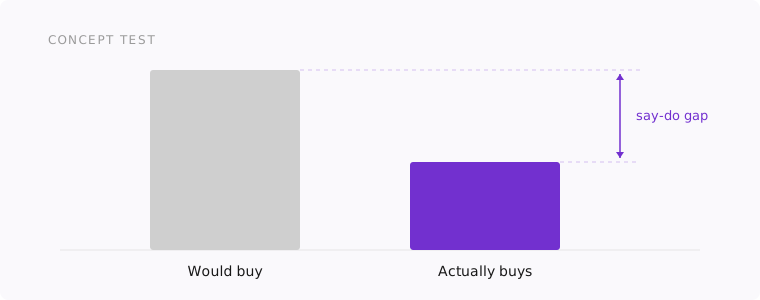
Most segmentations rely on demographics and surveys. Both describe who someone is or what they claim to do, not what they actually buy. The result is segments that sound plausible but barely show up in the market.
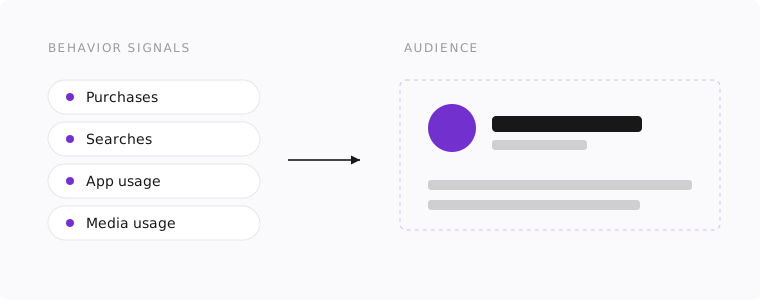
Behavioral segmentation flips this: it builds segments from observed purchase, browsing and media behavior. Demographically identical groups regularly fall into completely different purchase segments.
Men aged 35 to 44 spread across eight purchase clusters. Even the largest captures just 35.6% of them.
That comes from Datapods panel data: the remaining two thirds buy across seven other segments, and demographics explain barely one percent of which cluster a shopper lands in.
Our product for behavioral segmentation takes the opposite route: it builds segments from the actual purchases and sessions of over 25,000 panel participants. Two demographically identical people end up in different segments as soon as their behavior says so.
Frequently asked questions
- What is market segmentation?
- Market segmentation is the division of a total market into homogeneous groups (segments) that share similar needs, characteristics or behaviors, so they can be addressed in a targeted way.
- What are the segmentation criteria?
- The four classic criteria are geographic, demographic, psychographic and behavioral. In practice they are combined, because a single criterion rarely produces a sharply defined segment.
- What is the difference between market segmentation and target audience analysis?
- Market segmentation divides the total market into segments; it answers the 'how' of splitting. Target audience analysis then describes the chosen segments in detail: who they are and how they behave.
- How does market segmentation work in B2B?
- In B2B you segment by firmographic traits such as industry, company size and region, plus the buying and usage behavior of the organization and the decision-makers involved.