Competitive Analysis: Methods, Template and Example
What is competitive analysis? Methods (Porter, SWOT, benchmarking), a template and an example, plus how to analyze competitors on real customer data.
3 min read
Your customers buy elsewhere too. A competitive analysis shows where, why, and what you can do about it.
What is competitive analysis?
Competitive analysis is the systematic study of the competitors in a market: their strengths, weaknesses, offers, prices and strategies. The goal is to assess your own position realistically and to derive concrete decisions from it. It is often used interchangeably with the term competitor analysis. Within a broader market analysis, it is the building block focused on the competitors.
A good competitive analysis answers three questions: who are the relevant competitors, how well positioned are they, and where can you gain an advantage?
Methods of competitive analysis
Several methods have become established for the analysis:
- Porter's Five Forces: the five competitive forces of an industry (rivals, new entrants, substitutes, suppliers, buyers).
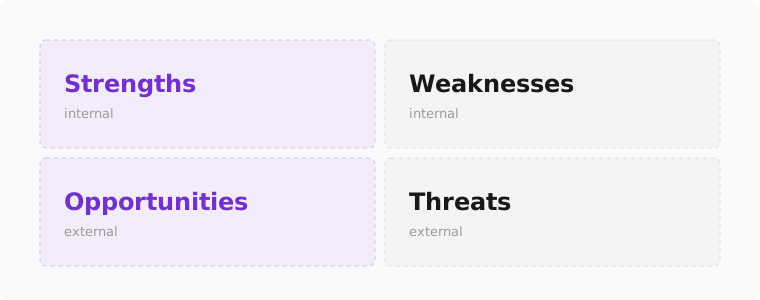
- SWOT analysis: strengths, weaknesses, opportunities and threats in direct comparison.
- Benchmarking: the measurable performance comparison against the best competitors.
- Competitive matrix: positioning competitors along two criteria.
No single method is complete on its own. In practice you usually combine a structure (Porter or SWOT) with a concrete comparison (matrix or benchmark).
Porter's Five Forces is worth a closer look, because it frames competition more broadly than just the direct rivals:
- Rivalry among competitors: how fierce is the fight for share?
- Threat of new entrants: how easy is it to enter the market?
- Threat of substitutes: are there alternatives outside the industry?
- Bargaining power of suppliers: how dependent are you on suppliers?
- Bargaining power of buyers: how much pressure can customers apply?
How to run a competitive analysis in 5 steps
- Identify competitors: direct and indirect players in the relevant market.
- Define criteria: offer, price, target audience, channels, positioning.
- Gather information: websites, prices, reviews, market data.
- Compare and score: put the competitors side by side in a matrix.
- Derive actions: where is an advantage possible, where is the threat?
Competitive matrix: template and example
A competitive matrix puts the competitors (rows) against the comparison criteria (columns), so patterns and gaps become visible at a glance. Using the example of a new oat-drink brand:
| Competitor | Price | Distribution | Audience |
|---|---|---|---|
| Brand A | Premium | Organic retail | Health-conscious |
| Brand B | Premium | Supermarket | Families |
| Brand C | Budget | Discounter | Price-conscious (offline) |
| Your brand | Mid | Online subscription | Price-conscious, digital |
The matrix reveals the gap: price-conscious customers on an online subscription that nobody currently occupies. That becomes the positioning, instead of attacking one of the already-taken spots.
Tools for competitive analysis
Tools mainly help with gathering: SEO and social-media tools show competitors' visibility and reach, while web analytics and market data provide context. The scoring and the decision remain the job of the analysis.
See where customers really go
Classic competitive analysis relies on what is publicly visible: websites, prices, advertising, annual reports. That shows what competitors do, but not where customers actually go.
Behavioral data flips the perspective. It shows which competitors your customers also buy from, how their spending is split (share of wallet), and who switches to whom.
41% of ABOUT YOU's buyers also buy at Zalando. The reverse is just 15%.
That comes from Datapods panel data: cross-shopping is rarely symmetric. The smaller player shares much of its base with the market leader, the leader barely feels it. Only real purchase behavior reveals patterns like that, not the public-facing picture.
Our product for data-driven competitive analysis closes exactly that gap: from real transactions, it reveals which competitors your customers also buy from and where they switch, instead of what is publicly visible.
Frequently asked questions
- What is competitive analysis?
- Competitive analysis is the systematic study of the competitors in a market: their strengths, weaknesses, offers, prices and strategies, in order to assess your own position realistically.
- What is the difference between competitive analysis and competitor analysis?
- There is none. The terms are used interchangeably and describe the same systematic study of the competition.
- What methods are used for competitive analysis?
- Common methods are Porter's Five Forces, SWOT analysis, benchmarking and the competitive matrix. In practice they are often combined.
- How do you run a competitive analysis?
- In five steps: identify the relevant competitors, define comparison criteria, gather information, compare and score them in a matrix, and derive actions from the result.