
Public Action Concentration Among Voicers on TikTok and YouTube in Germany — 2025
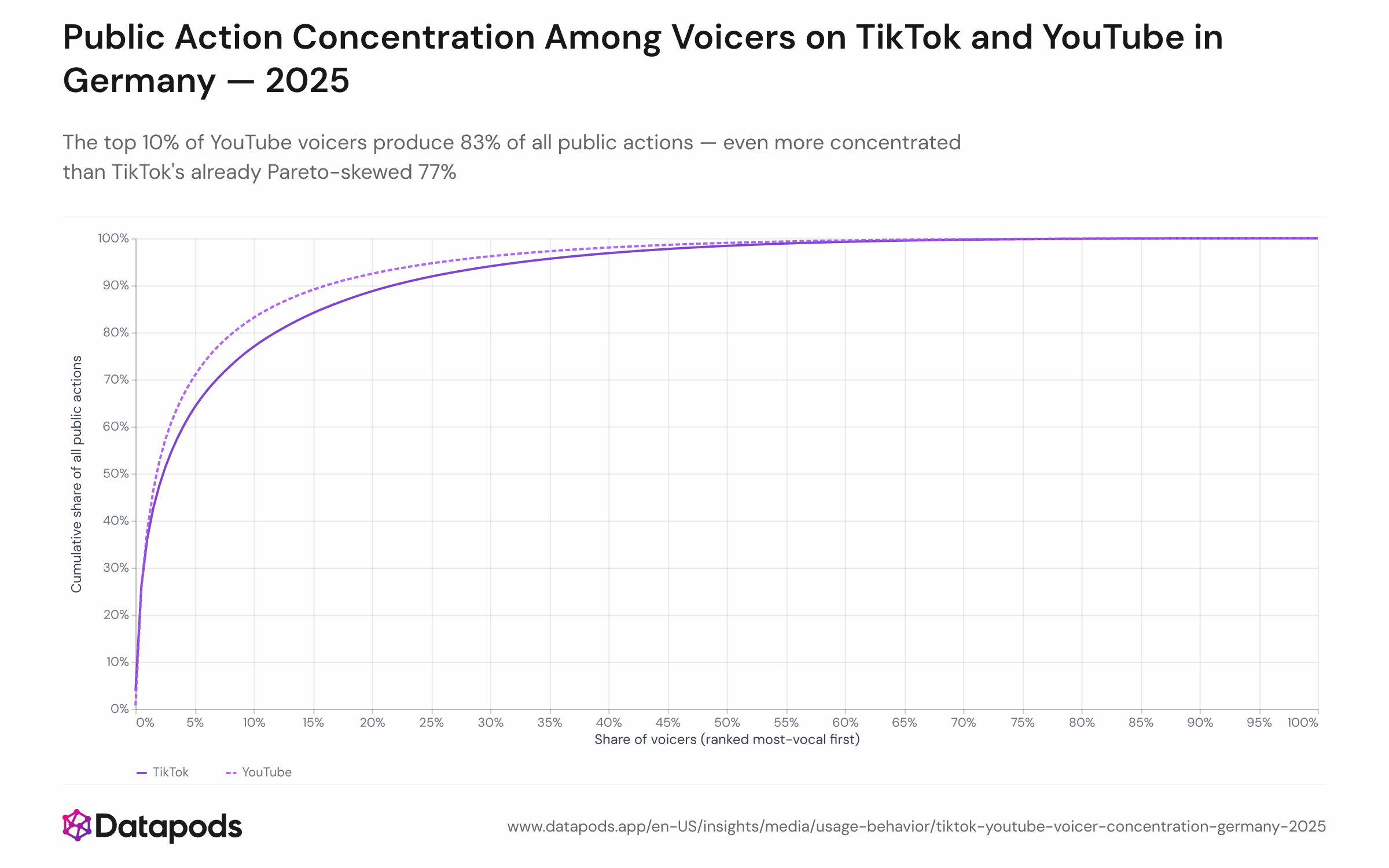
Review Full Year 2025: The top 10% of YouTube voicers produce 83% of all public actions — even more concentrated than TikTok's already Pareto-skewed 77%
Info
- Sample size
- n = 28,695
- Data date
- Full Year 2025
- Segment
- All segments
- Platform
- TikTok, YouTube
- Market
- Germany
Analysis
Despite three-quarters of active users qualifying as voicers on both platforms, the actual production of public content is radically top-heavy: on YouTube, 83% of all likes, dislikes, and votes in 2025 were generated by just 10% of voicers — and 47% by the top 1% alone.
Platforms are democratic in reach but aristocratic in signal
The 90-9-1 rule's deeper truth survives even when the lurker share collapses: the concentration of public output among a tiny super-voicer minority is, if anything, steeper on today's mass-market platforms than in earlier web communities. YouTube's concentration (83% from the top decile) exceeds TikTok's (77%) despite YouTube having a far larger absolute voicer base of 20,737 users. This counterintuitive result likely reflects YouTube's like-driven voicing mechanic: the same small group of highly engaged users who watch the most content also generate the most likes, creating a compounding loop. TikTok's comment-and-post layer, though rarer in absolute terms, distributes somewhat more evenly among those who use it — suggesting that composition-based actions attract a broader motivated minority than a single-tap reaction. For marketers reading sentiment from comment sections or like ratios, both platforms' public signals are effectively the voice of a tiny, unrepresentative super-user layer. See also how voicer rates break down by platform and age group.
This analysis is based on public segment data. For deeper cuts, use our Enterprise interface.
Methodology
The concentration analysis was conducted within the voicer subset — users who produced at least one public action during 2025 — on each platform: 7,958 TikTok voicers and 20,737 YouTube voicers among active German users. Voicers were ranked from highest to lowest total public-action count. Cumulative public-action shares were then calculated at each percentile rank to produce a Lorenz-style concentration curve. The curves were downsampled to 200 data points each for display. Top-1% and top-10% thresholds are read directly from the cumulative curve. The within-platform concentration metric is not sensitive to the overall composition of the panel.