
Heavy-Voicer Share by Age Group on TikTok and YouTube in Germany — 2025
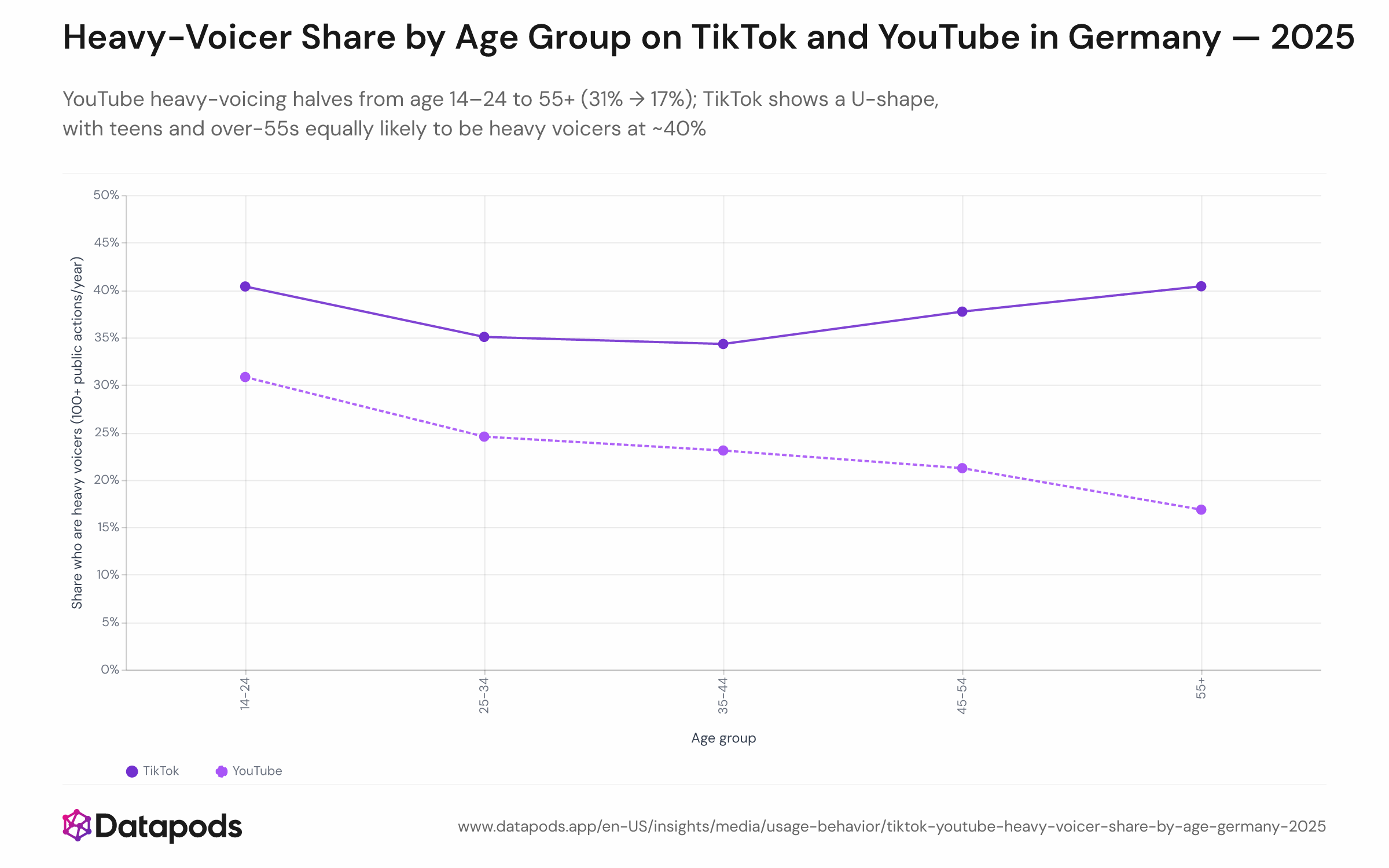
Review Full Year 2025: YouTube heavy-voicing halves from age 14–24 to 55+ (31% → 17%); TikTok shows a U-shape, with teens and over-55s equally likely to be heavy voicers at ~40%
Info
- Sample size
- n = 36,432
- Data date
- Full Year 2025
- Segment
- 16-24, 25-34, 35-44, 45-54, 55+
- Platform
- TikTok, YouTube
- Market
- Germany
Analysis
TikTok's age-voicing curve is a near-perfect U: both the youngest (14–24) and oldest (55+) active users hit ~40% heavy-voicer share, while the 25–44 cohort dips to ~34%. YouTube runs in the opposite direction — a clean, monotonic decline from 31% at 14–24 to 17% at 55+.
TikTok's algorithm creates equal conditions across generations; YouTube's like culture skews young
YouTube's decline with age matches the broader pattern visible across social platforms: digital nativity and social-validation norms are strongest in younger cohorts, and the path of least resistance — tapping a like — is a behaviour reinforced through years of daily use. Older YouTube users are heavy consumers but lighter reactors, consistent with research showing that over-55 internet users skew toward informational rather than participatory modes of engagement. TikTok's U-shape is more surprising. The 55+ resurgence likely reflects two factors: a self-selected group of older German TikTok users who adopted the platform precisely because of its community features, and TikTok's algorithmically driven feed that surfaces content in niche interest areas — cooking, gardening, nostalgia — where older users respond at high rates. For brands targeting both Gen Z and older demographics on TikTok, the U-shape means neither end of the age spectrum should be treated as a passive audience.
This analysis is based on public segment data. For deeper cuts, use our Enterprise interface.
Methodology
Heavy-voicer share was calculated within each age cohort for active German users with a known birth year on each platform. A user was classified as a heavy voicer if they accumulated 100 or more public actions — comments, posts, and shop reviews on TikTok; likes, dislikes, and votes on YouTube — over the full 2025 calendar year. Age groups with fewer than 30 users in either platform's panel were excluded. Cell sizes range from 458 users (TikTok 55+) to 8,424 users (YouTube 25–34), covering a total of 36,432 users across both platforms.