
GfK Consumer Confidence vs. Digital Frugality Signals in Germany — Scatter Plot, Jan 2025–Apr 2026
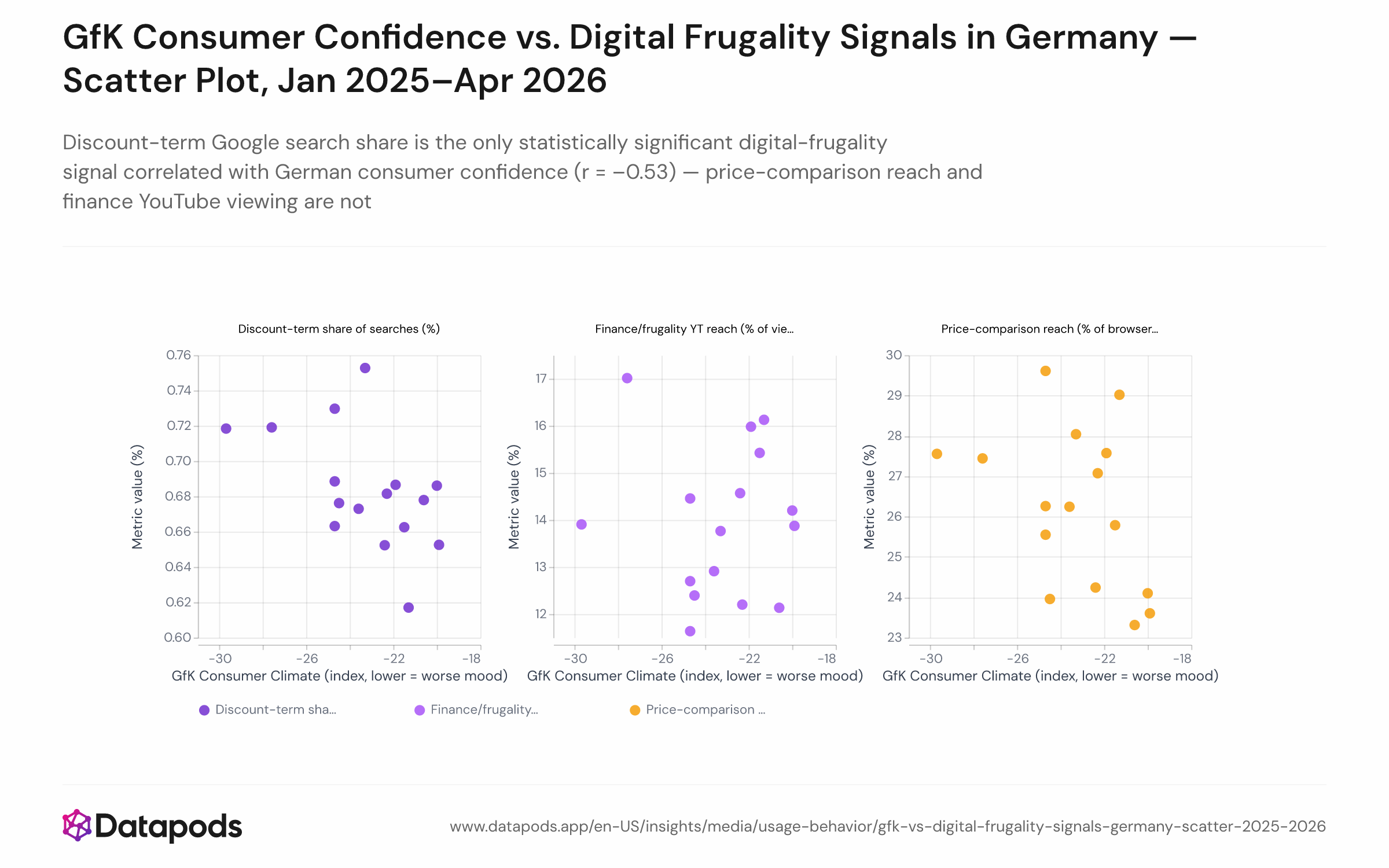
Review Jan 2025–Apr 2026: Discount-term Google search share is the only statistically significant digital-frugality signal correlated with German consumer confidence (r = –0.53) — price-comparison reach and finance YouTube viewing are not
Info
- Sample size
- n = 4,252
- Data date
- Jan 2025–Apr 2026
- Segment
- All segments
- Platform
- Browsing, Search, YouTube
- Market
- Germany
Analysis
Plotting 16 monthly observations against the GfK/NIM Consumer Climate index reveals a clear hierarchy among three digital-frugality signals: the discount-term share of German Google searches carries the strongest negative relationship (r = –0.53), price-comparison site reach shows a moderate directional link (r = –0.42), and personal-finance YouTube reach shows none (r = –0.03).
Search intent reveals pressure faster than browsing or viewing
The finding makes intuitive sense: typing 'lieferando gutschein' or 'temu gutscheincode' into a search bar is an immediate, transactional behaviour that responds quickly to budget pressure — it requires active intent. Visiting a price-comparison site is a step further removed, and watching a finance channel is driven largely by content supply and algorithm recommendations rather than by household stress. Germany's consumer mood deteriorated persistently through this window, with the GfK/NIM index declining from around –20 in mid-2025 to –28 in April 2026, and the propensity to save reaching its highest level since the 2008 financial crisis at the end of 2025. In that environment, the search layer proved the most sensitive real-time indicator of how digital behaviour in Germany responds to economic pressure.
This analysis is based on public segment data. For deeper cuts, use our Enterprise interface.
Methodology
Each of the 16 data points represents one calendar month from January 2025 to April 2026. The x-axis is the GfK/NIM Consumer Climate index for that month, taken from official NIM press releases. The y-axis shows one of three digital-frugality metrics: (1) share of active browsers visiting price-comparison domains, (2) discount-term share of all Google searches, or (3) share of YouTube-active users watching personal-finance channels. Pearson correlation coefficients are computed across all 16 monthly pairs for each signal independently. The three signal series are described in full in their respective trend charts.