
Eurovision 2026 Attention Index Across Platforms in Germany — April–May 2026
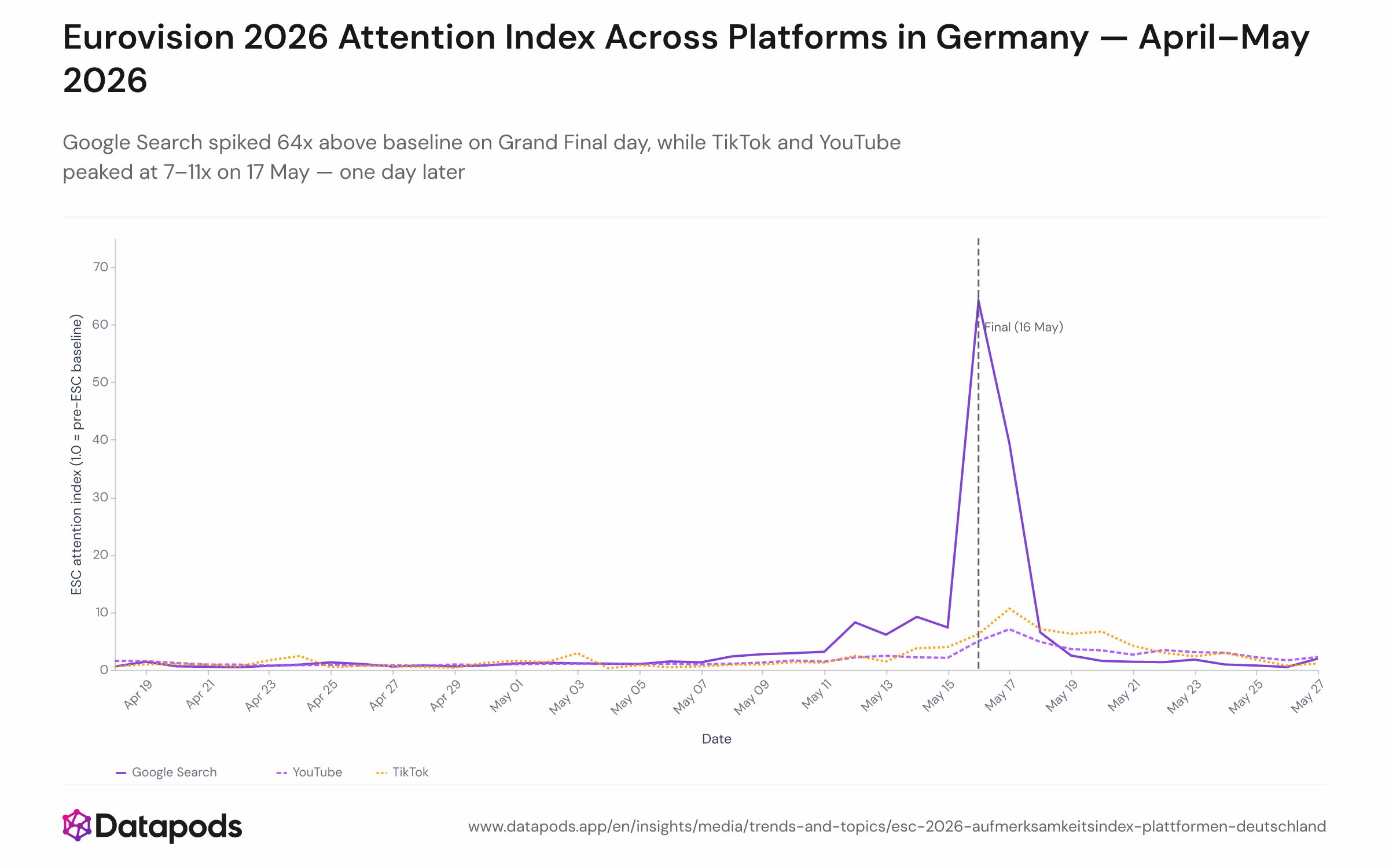
Review 16–17 May 2026: Google Search spiked 64x above baseline on Grand Final day, while TikTok and YouTube peaked at 7–11x on 17 May — one day later
Info
- Sample size
- n = 10,888
- Data date
- 16–17 May 2026
- Segment
- All segments
- Platform
- Browsing, Search
- Market
- Germany
Analysis
Across all three platforms measured, the Eurovision Song Contest 2026 generated the largest synchronized digital surge recorded in the observation window — but with a clear one-day lag between search and social-video platforms. Google Search hit its 64x peak on 16 May (Grand Final day), while both TikTok and YouTube peaked at 7–11x on 17 May, the morning after the final.
The anatomy of a real-time vs. reaction media cycle
The pattern reveals two distinct platform roles. Google acted as a real-time companion: audiences searched for live results, scoreboard updates, and "Bangaranga" lyrics as the Vienna show unfolded. TikTok and YouTube absorbed a different impulse — the post-result wave of reaction clips, performance replays, and viral edits that proliferated once Bulgaria's surprise victory was confirmed. "Bangaranga" had already cleared 8 million TikTok views in the lead-up to the final; after the win, reaction and recap formats became the dominant content type. The contest's 70th-anniversary status, broadcast to 148 countries with votes from a record number of participating nations, amplified the international content supply feeding German social feeds. The structural lag between search and video-platform peaks is a repeatable signature of large live-broadcast events and a practical guide for media planners targeting Eurovision streaming audiences in Germany.
This analysis is based on public segment data. For deeper cuts, use our Enterprise interface.
Methodology
The attention index normalises each platform's daily Eurovision engagement to its own pre-ESC baseline (18 April – 8 May 2026 = 1.0). For Google Search, the metric is ESC-related queries as a share of total daily queries. For YouTube, it is ESC-related watch-time as a share of total daily watch-time. For TikTok, it is ESC-related video interactions as a share of total daily video interactions, with ESC videos identified through description and audio metadata keyword matching. All three series are plotted on the same index scale to allow cross-platform comparison of timing and magnitude. The observation window runs from 18 April to 27 May 2026 among German online users.
These insights are based on the Datapods Panel. Our data comes exclusively from users who are compensated for their anonymity. Become part of the panel & earn from your data