
Price-Comparison Site Reach by Age Group Among German Online Shoppers — 2025 to Q1 2026
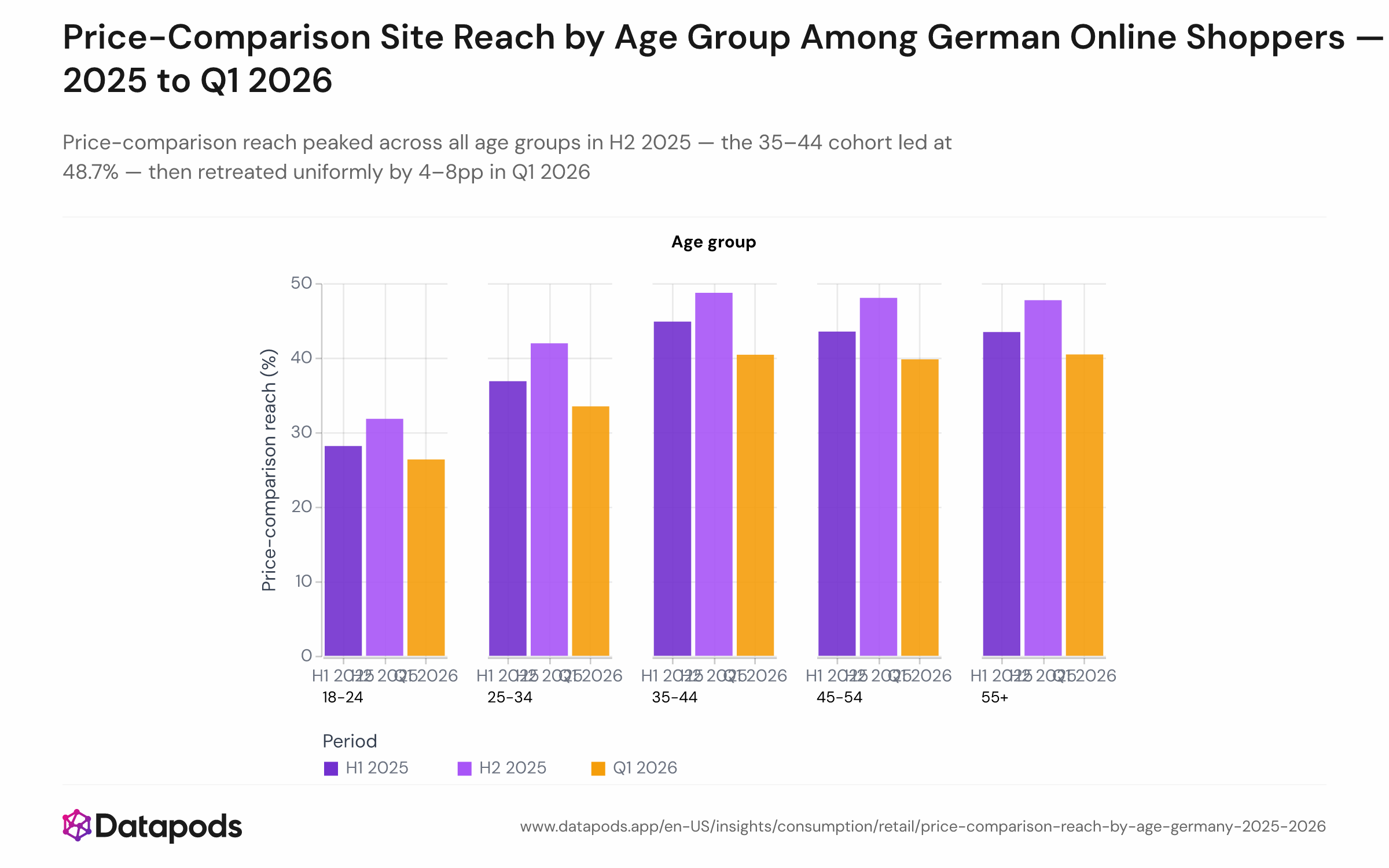
Review 2025 – Q1 2026: Price-comparison reach peaked across all age groups in H2 2025 — the 35–44 cohort led at 48.7% — then retreated uniformly by 4–8pp in Q1 2026
Info
- Sample size
- n = 42,803
- Data date
- 2025 – Q1 2026
- Segment
- All segments
- Platform
- Browsing
- Market
- Germany
Analysis
Across every age cohort, price-comparison site reach climbed steadily through the first half of 2025 and crested in the second half — 35–44 year-olds hit 48.7%, 45–54 hit 48.0%, and 55+ hit 47.7%. Younger shoppers aged 18–24 showed the lowest baseline at just 28–32% throughout, a gap that held stable across the entire period.
A uniform retreat rules out a cohort story
The Q1 2026 pullback of 4–8 percentage points hit every age group equally, which is the finding's most consequential detail for retail marketers and analysts tracking Sparverhalten im Onlinehandel. If the retreat were confidence-driven, older or more financially cautious cohorts would have held or increased usage. Instead, the synchronized contraction points to a broader behavioral shift — possibly reflecting a change in how shoppers use price-comparison tools relative to search and social discovery — rather than any one demographic losing faith in the Preisvergleich habit. The overall price-comparison reach trend provides the full monthly context behind these half-year snapshots.
This analysis is based on public segment data. For deeper cuts, use our Enterprise interface.
Methodology
For each six-month period (H1 2025, H2 2025, Q1 2026), the share of active German online shoppers in each age group who visited at least one major price-comparison portal was calculated. Age groups are based on birth year. Shoppers without a recorded birth year were excluded. Active shoppers are those with any recorded browsing activity in the relevant period. Q1 2026 covers January through March (complete months only). Each age-period cell contains between approximately 1,100 and 5,100 participants.