
Amazon Prime Day 2025 Average Basket Value by Category in Germany — Before, During, and After
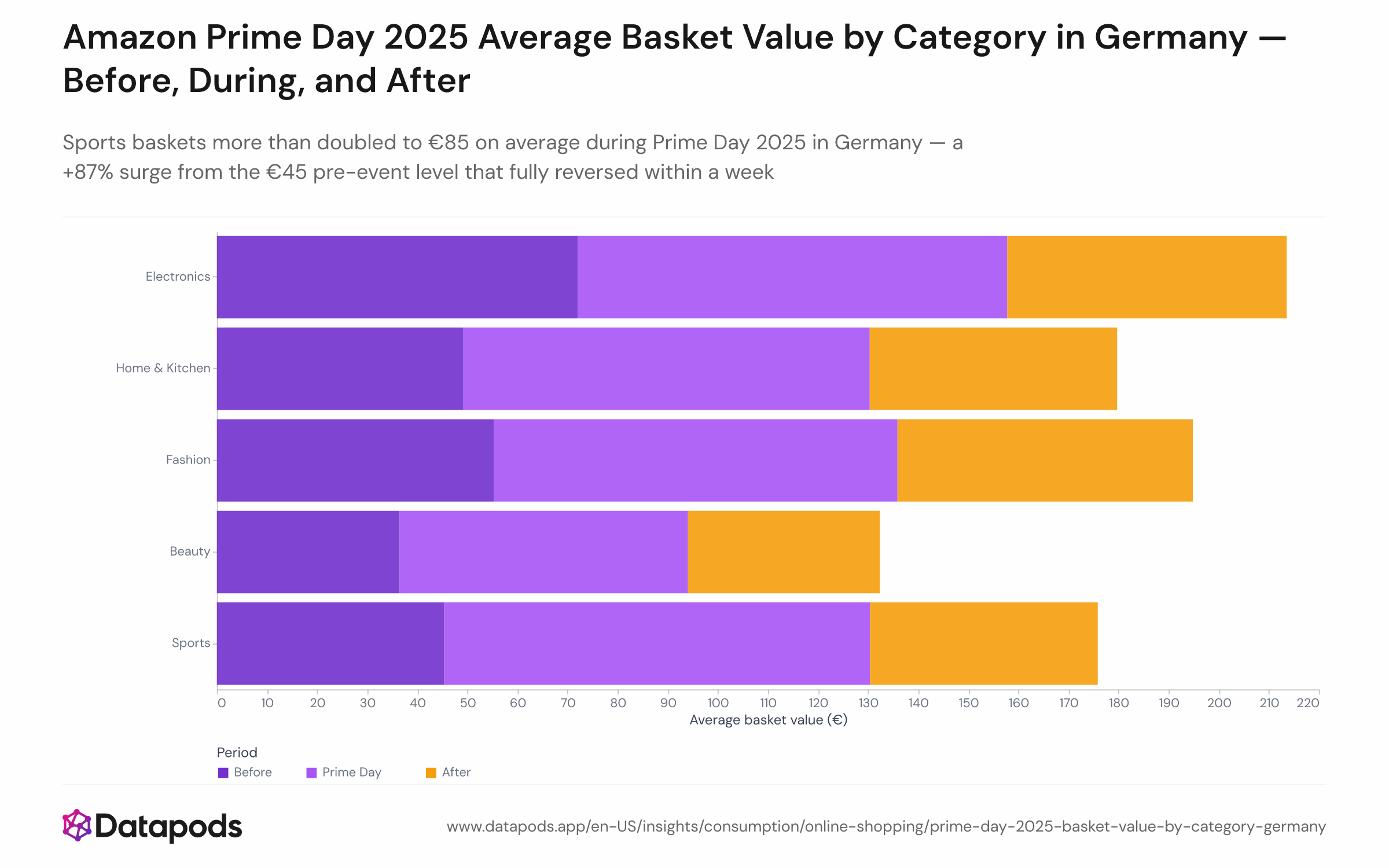
Review July 2025: Sports baskets more than doubled to €85 on average during Prime Day 2025 in Germany — a +87% surge from the €45 pre-event level that fully reversed within a week
Info
- Sample size
- n = 6,542
- Data date
- July 2025
- Segment
- All segments
- Platform
- Purchases
- Market
- Germany
Analysis
German Amazon shoppers didn't just buy more often during Prime Day 2025 — they spent significantly more per order. The Sports category saw the sharpest basket value jump (+87%, from €45 to €85), followed by Home & Kitchen (+65%, from €49 to €81). Even Electronics, already the highest pre-event basket at €72, climbed to €86. Across all categories, values fully reverted to near-baseline within seven days of the event closing.
High-ticket pull-forward: the Prime Day basket mechanics
The pattern across all three categories reflects what retail analysts describe as considered purchase pull-forward: shoppers use Prime Day to bring forward planned, higher-value purchases rather than adding low-cost impulse items. NIQ data for Prime Day 2025 globally showed over-indexing for products in the €100–€400 price range, consistent with the Sports and Home & Kitchen basket jumps observed in Germany. The sharp post-event reversion confirms spending was genuinely redistributed in time, not created from scratch — a structural dynamic that will likely repeat at Prime Day 2026 in June, where the WM 2026 calendar could amplify big-ticket electronics and outdoor gear purchases.
This analysis is based on public segment data. For deeper cuts, use our Enterprise interface.
Methodology
Average basket value per order was calculated for German Amazon.de shoppers across three periods: seven days before Prime Day (July 1–7, 2025), the four-day event (July 8–11, 2025), and seven days after (July 12–18, 2025). The basket value per order is the sum of item values within a single transaction. Each order is assigned to a product category based on taxonomy classification; orders spanning multiple categories are assigned to their primary category. Orders without a matched product code are excluded.