
YouTube Watch Time Format Share by Age Group in Germany — 2025
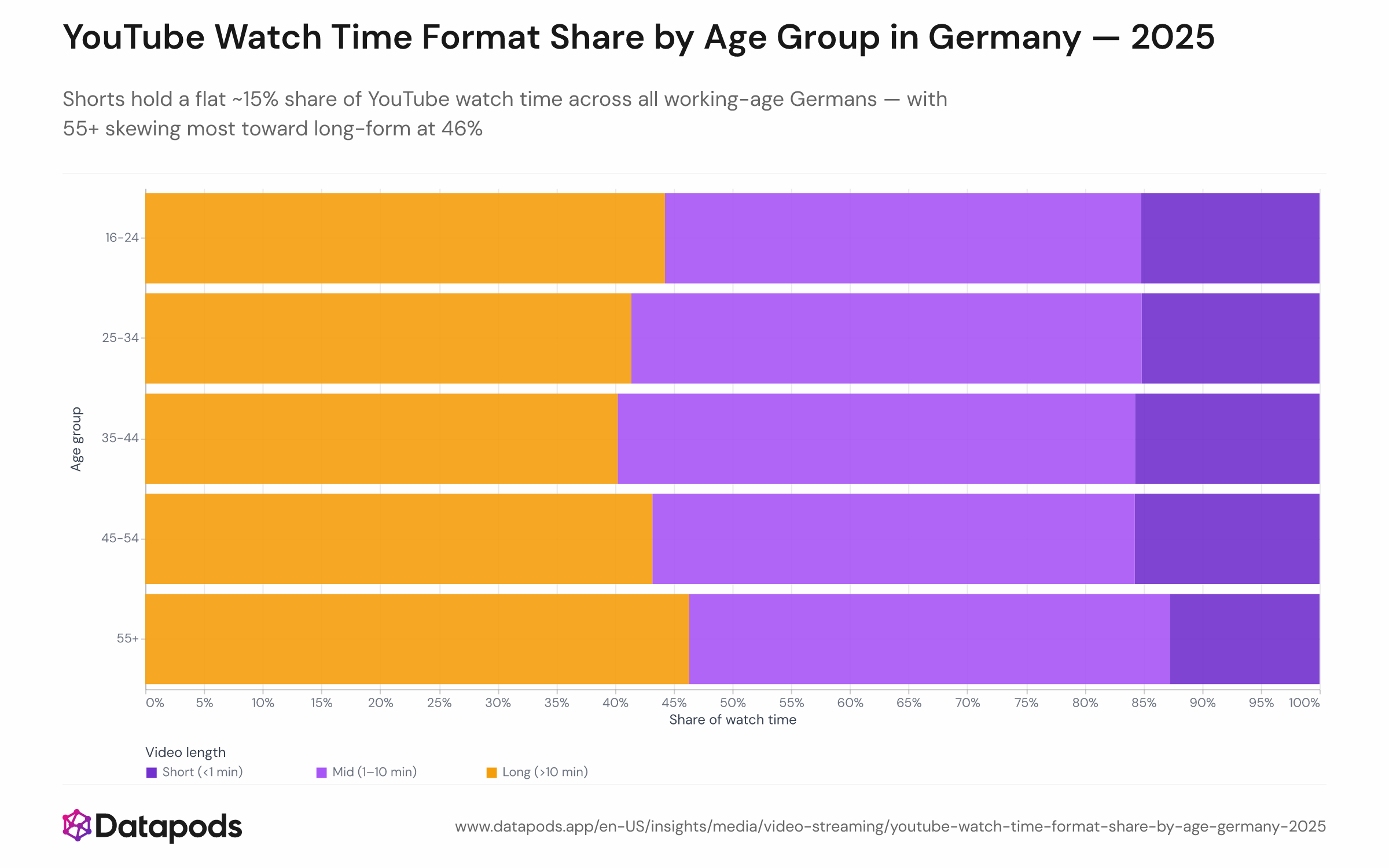
Review Full Year 2025: Shorts hold a flat ~15% share of YouTube watch time across all working-age Germans — with 55+ skewing most toward long-form at 46%
Info
- Sample size
- n = 24,550
- Data date
- Full Year 2025
- Segment
- All segments
- Platform
- YouTube
- Market
- Germany
Analysis
One of the most striking findings in German YouTube Nutzungsverhalten 2025: Shorts' share of total watch time is almost identical across the 16–54 age range — sitting in a narrow 15.2–15.7% band — before dipping to 12.8% for the 55+ group. The format composition shift across ages is surprisingly small. Long-form is highest for 55+ (46.3%) and 16–24 (44.3%); mid-form peaks for 35–44 (44.1%).
Why Gen Z and Boomers both gravitate to long-form
The near-identical Shorts share across all ages challenges the widespread assumption that YouTube Shorts Nutzungsdauer Deutschland is primarily a Gen-Z story. Globally, YouTube Shorts is the most-used short-form platform across all generations, particularly popular among Boomers+ (63%) and Gen X (66%). In Germany, the watch-time composition data reinforces this: it is not which format older users choose, but how much they watch overall that differs. Younger cohorts' higher total volume — detailed in the daily intensity breakdown by age and format — means their Shorts minutes are larger in absolute terms, but the proportional split stays nearly flat. For media planners, this upends a simple demographic shorthand: Shorts as a format is not disproportionately owned by any single age group in Germany.
This analysis is based on public segment data. For deeper cuts, use our Enterprise interface.
Methodology
Format shares are calculated as each length category's total watch time divided by the cohort's total watch time, for full-year 2025. The population is German YouTube users aged 16 and above with at least one active YouTube day in 2025, grouped into five age cohorts: 16–24, 25–34, 35–44, 45–54, and 55+. Length categories: Shorts (under 60 seconds), mid-form (1–10 minutes), long-form (over 10 minutes). Videos without duration metadata are excluded. Total sample covers 24,550 unique users.