
Necessity vs. Discretionary Spending on Amazon Germany — Q1 2025 to Q1 2026
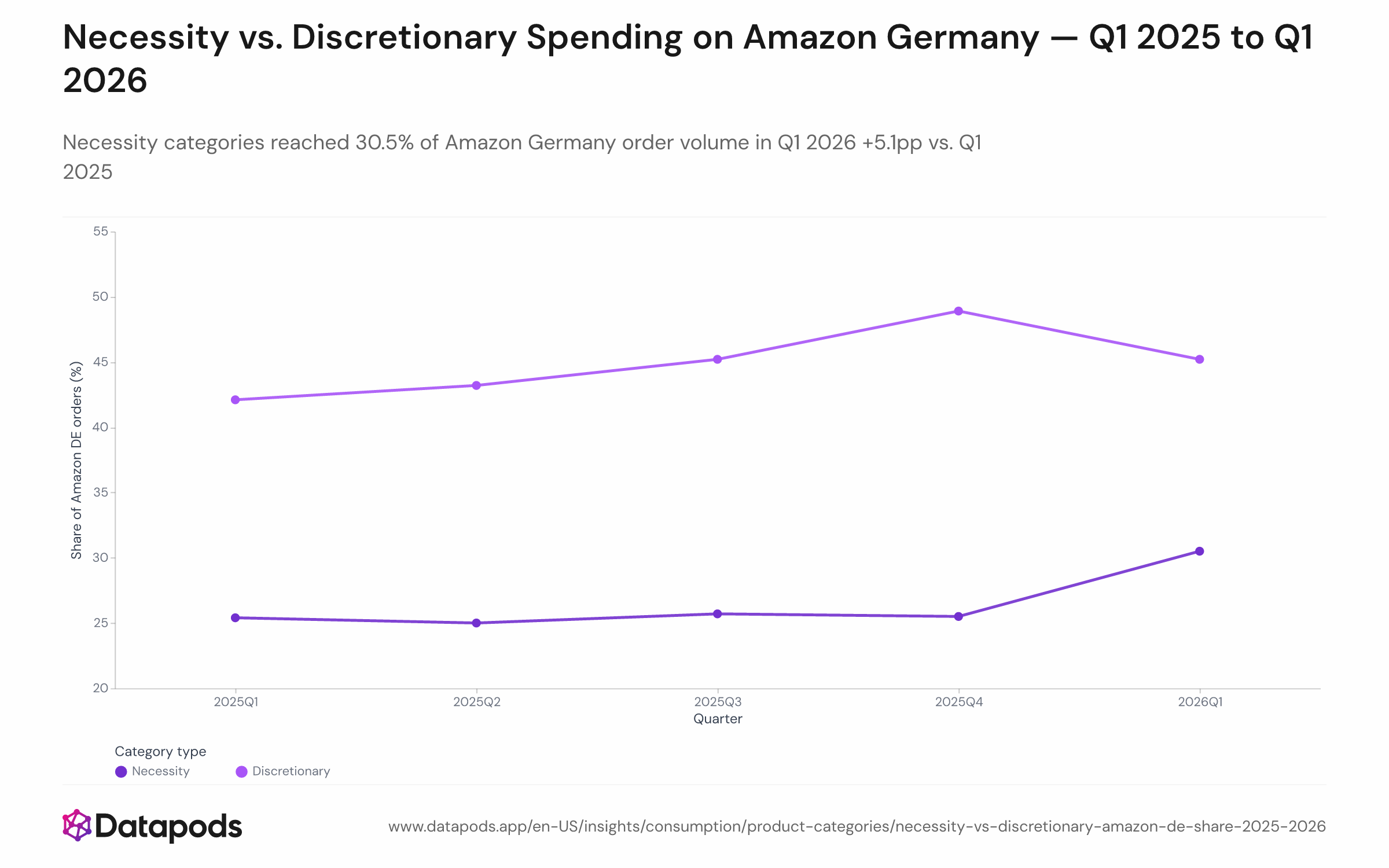
Review Q1 2025 – Q1 2026: Necessity categories reached 30.5% of Amazon Germany order volume in Q1 2026 +5.1pp vs. Q1 2025
Info
- Sample size
- n = 7,949
- Data date
- Q1 2025 – Q1 2026
- Segment
- All segments
- Platform
- Purchases
- Market
- Germany
Analysis
Necessity categories — Drugstore & Personal Care, Food & Groceries, Cosmetics, Pet, and Baby — held a stable share of roughly 25% of Amazon Germany orders throughout 2025, then surged to 30.5% in Q1 2026, the sharpest single-quarter jump in the observation window. The holiday-season discretionary peak of 48.9% in Q4 2025 gave way to a meaningful retreat, signalling a structural, not merely seasonal, shift in German online shopping behaviour.
Defensive spending amid a weakening Konsumklima
The jump coincides with a sharp deterioration in German consumer sentiment. The GfK Konsumklima indicator fell to –26.9 points in January 2026 — its lowest since April 2024 — driven by rising savings intentions that hit their highest level since the 2008 financial crisis. Against that backdrop, shoppers on Amazon Germany redirected wallet share toward replenishable, non-postponable goods. The pattern mirrors what broader FMCG research shows for the German market: even when overall online spending grows, necessity categories are capturing a disproportionate share of the increment. See category-level growth rates for the individual drivers behind this shift.
This analysis is based on public segment data. For deeper cuts, use our Enterprise interface.
Methodology
Purchase orders placed on the Amazon Germany marketplace by active German online shoppers were tracked across five consecutive quarters from Q1 2025 through Q1 2026. Categories were classified as necessity (Drugstore & Personal Care, Food & Groceries, Cosmetics, Pet, Baby) or discretionary (Fashion, Electronics, Home & Décor, Toys, Sports). The metric shown is the share of total order volume attributed to necessity categories per quarter, computed across all shoppers who placed at least one Amazon Germany order during the observation window.