
Amazon Spend Gap: Rural and Suburban vs. Urban Germany — January 2025 to March 2026
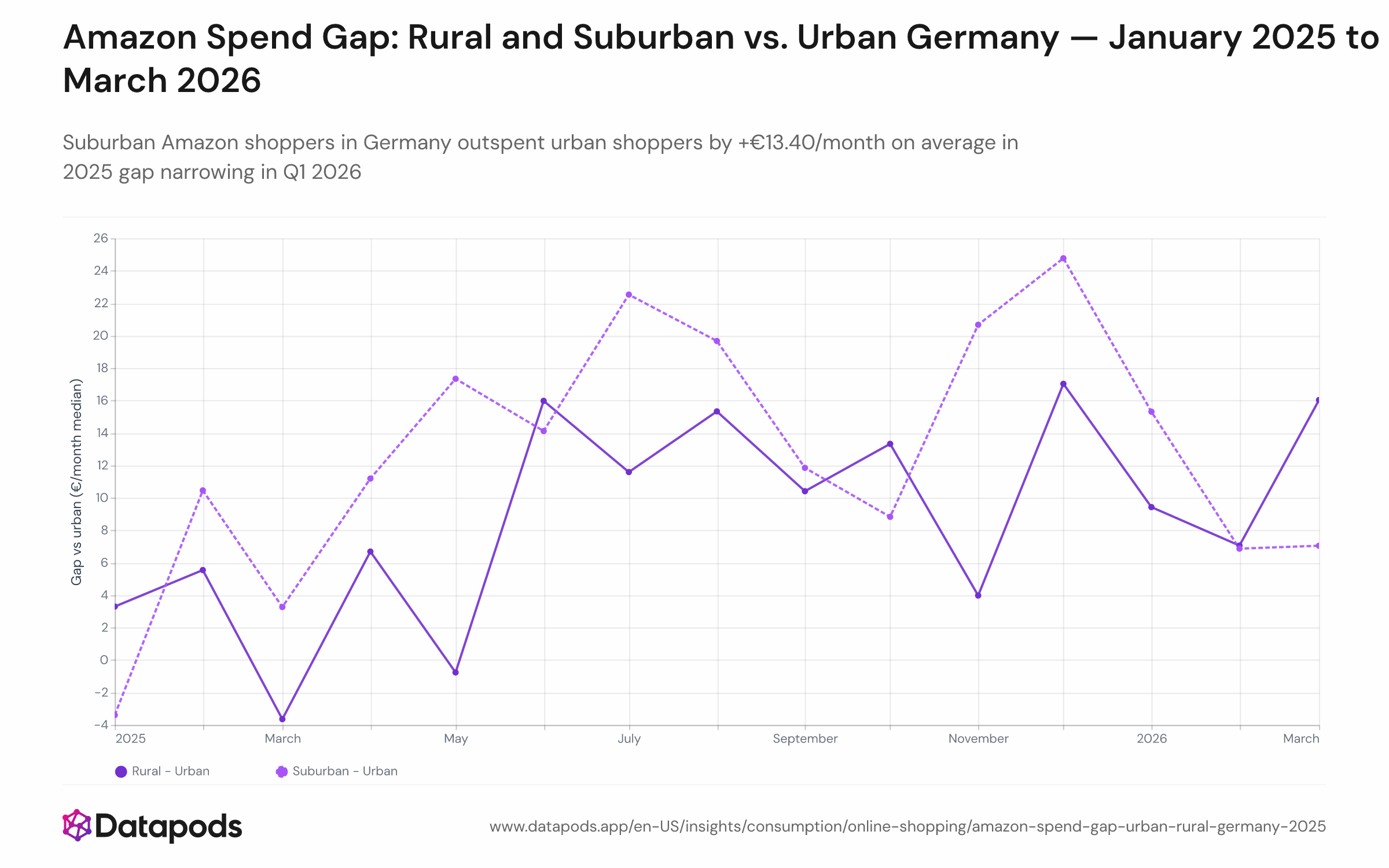
Review Jan 2025–Mar 2026: Suburban Amazon shoppers in Germany outspent urban shoppers by +€13.40/month on average in 2025 gap narrowing in Q1 2026
Info
- Sample size
- n = 4,011
- Data date
- Jan 2025–Mar 2026
- Segment
- All segments
- Platform
- Amazon, User
- Market
- Germany
Analysis
Rural and suburban Amazon shoppers in Germany outspent urban shoppers in 25 of 27 monthly comparisons from January 2025 to March 2026. The average 2025 gap was +€8.90/month for rural and +€13.40/month for suburban — both consistently positive. In Q1 2026, the gaps narrowed to +€10.80 (rural) and +€9.70 (suburban), moving in the opposite direction from a 'rural stagnation, urban growth' narrative.
The 'urban-growth' story doesn't hold for Amazon Germany
Conventional e-commerce analysis in Germany often frames urban areas as the engine of online spending growth, partly because quick-commerce and same-day delivery have expanded most aggressively in cities. The 15-month Amazon order data tells a different story: non-urban Germany has been the stronger spending cohort throughout 2025, and the early-2026 gap narrowing reflects a proportional post-holiday cooldown rather than urban catchup. The gap series isolates the relative performance cleanly: even as all segments declined after November 2025, rural and suburban shoppers maintained their lead. This regional pattern in monthly spend is closely linked to the higher order frequency among suburban shoppers shown in order frequency and basket size.
This analysis is based on public segment data. For deeper cuts, use our Enterprise interface.
Methodology
The spending gap is calculated as the difference between the median monthly Amazon.de spend of rural or suburban shoppers and that of urban shoppers, for each month from January 2025 to March 2026. A positive value means non-urban shoppers spent more than urban shoppers that month. The underlying metric is median spend per active shopper, drawn from the same 4,011-person German Amazon cohort. Shoppers are classified as urban (within 10 km of a city with 150,000+ residents), suburban (10–30 km), or rural (beyond 30 km). Pre-2025 data is excluded because the cohort was too small before November 2024 to yield stable monthly medians.