
Every Cultural Relevance Score in 2026 Is Built on the Loudest 1%
New Datapods panel data: 96.6% of cultural engagement is silent. The top 1% of users generate 62.5% of all public actions across TikTok and YouTube.
By David Goldschmidt & Leander Kühr·May 19, 2026·6 min

Within the past months, several companies launched products promising to make cultural relevance "measurable." Each of these systems is built on real data. None of them is built on what people actually do.
This is not a coincidence. It is a structural feature of an industry built on a single load-bearing premise that culture is mystical in nature. But mysticism is not the nature of culture. It is what happens when you try to measure something without the data that would tell you whether your measurements mean anything. Surveys produce numbers. Sentiment AI produces numbers. Both are real, valuable signals. Neither can tell you which of its numbers actually predict behavior, unless you have the data to check against. Without that ground truth, every score has to be interpreted. And that is where the mysticism lives.
Two methods. Both real. Both incomplete.
Every cultural intelligence product on the market runs on at least one of two inputs. Both produce real data. Neither can be reliably interpreted on its own.
The first is the survey. Surveys are excellent instruments. They tell you what people will say to a researcher about themselves, and that is real information. It captures aspiration, identity claim, social desirability, stated preference. But what it cannot tell you, alone, is whether the answer matches the behavior.
Take sustainability: The textbook example of a value that surveys consistently rank near the top for Gen Z consumers. In our 2025 German consumer panel, even the most culturally-engaged users, those who both publicly liked sustainability content on YouTube and actively searched for sustainability on Google, still bought from Shein, Temu, H&M and Zara at 32.8%. Users with zero sustainability signal bought at 36.5%. The maximum culturally-engaged profile a brand could ask for is 3.7 percentage points away from the people who never engaged at all.
The internal structure is even harder to argue with. Users who publicly liked sustainability content but never searched for it bought fast fashion at 39%, higher than the no-signal baseline. Public endorsement without active intent is not weakly predictive of sustainable behavior. It is anti-correlated with it. Across every combination of signals we measured, the total spread between the most and least culturally engaged user types was 7.2 percentage points. That is the band.
These are exploratory findings from a German behavioral panel, not population-level claims. The most-engaged combined-signal group is a small slice of the data, and the sustainability signal is broad by design. Treat the numbers as directional. But the direction is what matters. Across every cut of the data, public cultural endorsement of sustainability does not predict a meaningful shift away from fast fashion purchasing. In several configurations, it predicts the opposite.
The survey is not wrong. The Gen Z consumer does, in some sense, value sustainability; it is how she wants to be seen. The like is not wrong either; it is a real expression of how she wants to be perceived in that moment. But a culture marketing campaign that earns thousands of likes on sustainability content is moving a metric that has essentially no measurable relationship to what people will buy. The loud approval is real, the behavior change is not. Without behavioral data beside the signal, there is no way for a brand to tell the difference.
The second method is sentiment AI on public content. Such solutions scrape public posts and infer meaning from language. Public posts are real culture too, they capture the visible layer of community discourse, the codes a community wants attached to its identity. But they are performance, calibrated for the audience the poster wants to be seen by, and the dataset is selection-biased to the loudest fraction of any community.
How loud? Loud enough to skew everything else.
Our 2025 panel data across TikTok and YouTube shows that 96.6% of cultural engagement is silent. Watches, private searches, hashtag saves, etc. that never enter any social listening dashboard. The public 3.4% sounds like a small slice. It is also a deeply skewed one: the top 1% of users generate 62.5% of all public actions; the top 5% generate 85%.
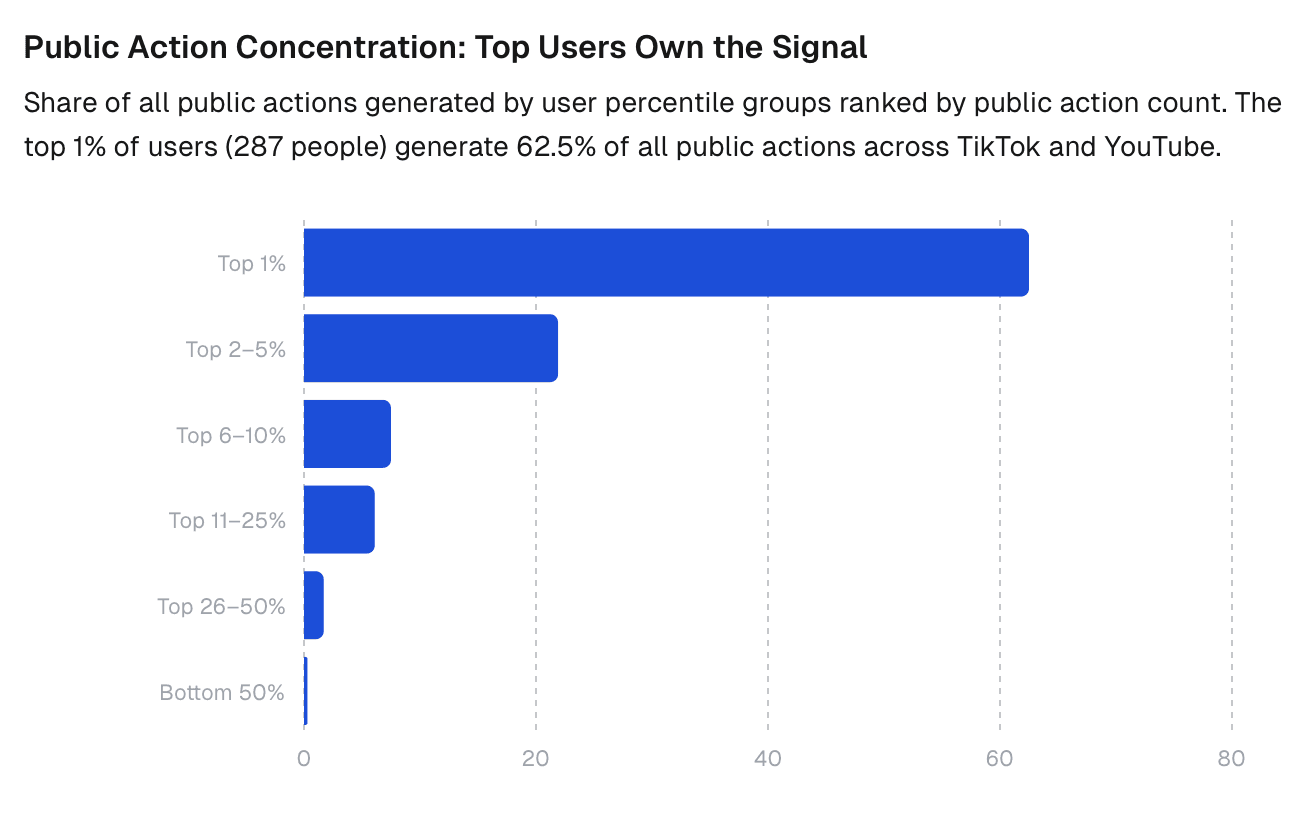
Read those numbers from a brand's perspective. A social listening dashboard, in effect, shows the brand what the loudest one percent of users talks about. The other 99% are counted in aggregate metrics but absent as voices. Sentiment AI is not reading "the audience." It is reading the most prolifically public users in any community, then inferring the culture of the rest from them.
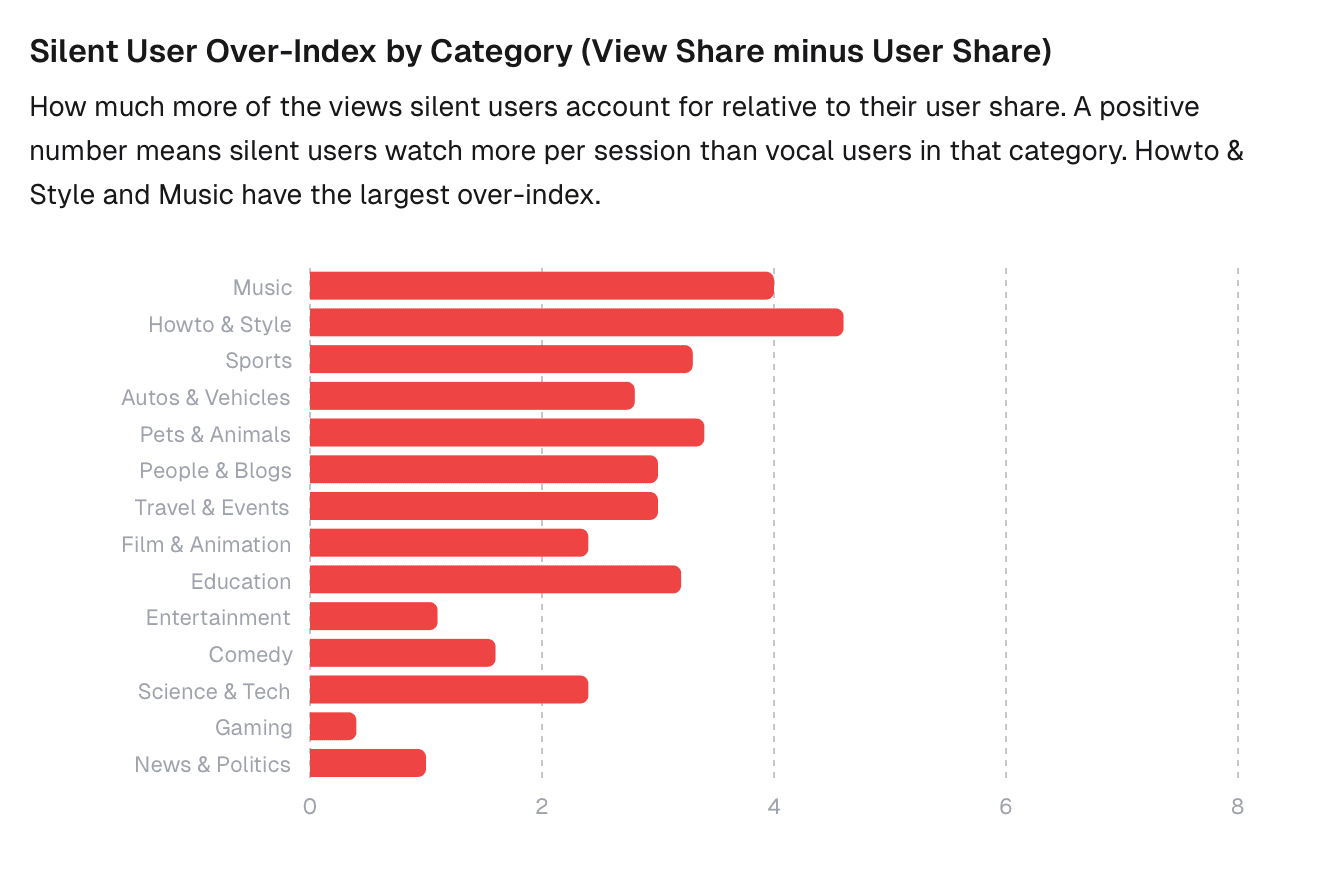
The distortion is not evenly distributed. In every YouTube category we measured, silent users generate more views per person than vocal ones. As a concrete read: if silent users are 73% of an audience but generate 77.9% of views, they over-index by +4 points — i.e. they watch more sessions per person than vocal users in that category. The gap is widest in the territories culture marketing cares about most. Silent users over-index by +4.6 points in Howto & Style, +4.0 in Music, +3.4 in Pets & Animals, +3.3 in Sports, the lifestyle categories where culture marketing actually lives. The two categories where vocal users come closest to parity are Gaming (+0.4) and News & Politics (+1.0): the territories where public discourse is the point of the platform.
A survey panel that weighted 1% of respondents at 62.5% of the result would be disqualified before publication. But because the same skew is baked into the underlying platforms, the industry has accepted public signals as if they were a fair sample. Every cultural score built on this layer is a confident reading of a sample whose representativeness has never been tested against the behavior it claims to predict.
So why is this wave of cultural scores hitting now? Because third-party cookies are dying, behavioral data is concentrating inside walled gardens, and the industries that historically connected stated preference to actual behavior (through panels, purchase data, observational research) are losing that connection just as the demand for "cultural relevance" peaks. The honest version of every culture marketing pitch in 2026 reads: we have signals, but no way to validate them, so we will sell you interpretation as if it were ground truth. The mystical framing is what makes the substitution sound like an upgrade.
Without behavior, everything is interpretation
The walled gardens are not the obstacle to cultural measurement. They are the recording studio. They contain the behavioral substrate that every survey, every sentiment score, every cultural relevance index is implicitly trying to predict. Every save is a vote. Every replay is a confirmation. Every silent share is a stronger signal than a public comment, precisely because no audience is watching. This data does not replace surveys or sentiment analysis. It gives them the ground truth they need to mean something. A survey answer becomes verifiable. A sentiment trend becomes representative. A cultural score becomes accountable to the behavior it was always trying to predict.
This is the gap Datapods exists to close. We make first-party behavioral data from inside the walled gardens accessible to brands and researchers. Not as a replacement for cultural intelligence, but as the foundation every cultural intelligence product has been trying to build on without. Once you have it, cultural relevance stops being mystical. It becomes the question the industry has always been asking, with the missing layer finally in place.
The data has been recorded all along.